Saturday, May 31, 2008

The Visitation of Our Lady

Photobucket
Today, we celebrate the feast of the Visitation of Our Lady to S. Elizabeth. The event is recorded in Luke 1:39-56. Having heard that her older cousin Elizabeth (who should be beyond child-bearing age) is six months pregnant, Mary goes to visit her in the hill country. We know that babies begin to hear in the womb at about 20 weeks. When Mary arrives, Elizabeth feels the baby kicking and says that the sound of Mary's voice is giving her baby cause to jump for joy in the womb.

I have wondered about the date of the feast. In the old kalendar, it was on July 2nd. In the new Kalendar, is it on May 31st. The old date of July 2 goes back to 1389 when Pope Urban VI established it as a feast to be kept throughout the Western Church. It was moved to May 31 in 1969 by Pope Paul VI in the revision of the kalendar. The date chosen was May 31st, which was already the minor commemoration of Mary as Queen of the Apostles. It would round out the month of May, which is particularly set aside for devotion to the Virgin. It would also bring the celebration in line with the timing of Christmas (six months before) and Annunciation (three months after) for Mary and for Elizabeth, it would coincide with the conception (six months after) and nativity (three months before) of John the Baptist.

Our little Matkin

Photobucket
For those interested in tracking baby updates, Melisa and I have set up a blog called Our Little Matkin. You can see how we are doing, see pictures, find our gift registry (there are no theology books in our registry, I promise), and our pregnancy countdown graphic. The momma is better about posting than I am, but my ideas are coming. Check it out.

Thursday, May 22, 2008

Let us forever adore the most holy Sacrament

Photobucket
O God our Father, whose Son Jesus Christ in a wonderful Sacrament, hath left unto us a memorial his passion: Grant us so to venerate the sacred mysteries of his Body and Blood, that we may ever perceive within ourselves the fruit of thy redemption; who livest and reignest, world without end. Amen.

Fantastic new product

Photobucket
Available here.

Wednesday, May 21, 2008

Lambeth on (new) provinces

The 1930 Lambeth Conference issued the following resolutions on the topic: "The Anglican Communion-Provincial Organisation."

Resolution 52
Saving always the moral and spiritual independence of the divine society, the Conference approves the association of dioceses or provinces in the larger unity of a "national Church," with or without the formal recognition of the civil government, as serving to give spiritual expression to the distinctive genius of races and peoples, and thus to bring more effectively under the influence of Christ's religion both the process of government and the habit of society.

Resolution 53
1. In view of the many advantages of the organisation of dioceses into provinces and the difficulties and dangers of isolation, the formation of provinces should everywhere be encouraged.
2. The minimum organisation essential to provincial life is a college or synod of bishops which will act corporately in dealing with questions concerning the faith, order and discipline of the Church.
3. The minimum number of dioceses suitable to form a province is four.
4. The balance between provincial authority and diocesan autonomy may vary from province to province according to the constitutions agreed upon in each case.

Resolution 54
Without prejudice to the provisions of any constitution already adopted by any province or regional Church, the Conference advises that when the bishops of a group of dioceses under the oversight of the Archbishop of Canterbury or attached to some other province have prepared and accepted a tentative constitution for a province, they should notify this to the authorities under which they have hitherto worked, and request that the new province be recognised as such and that they be released from obedience to other authority, as far as is necessary to enable them to subscribe to the constitution of the new province, and (if so required) take the oath of canonical obedience to its metropolitan. If this request be granted, the new province may then be formally constituted. The proper procedure would be that the bishops and clergy should subscribe to its constitution and that the bishops (if so required) should take the oath of canonical obedience to its metropolitan. The metropolitan or presiding bishop should thereupon notify all metropolitans and presiding bishops in the Anglican Communion of the formation of the province.

Two bishops, same city, same issue, two views

With totally opposite comments as Christian leaders. The issue is the 4-3 ruling of the California Supreme Court on May 15th , 2008 to strike down California's existing statutes limiting marriage to opposite-sex couples as unconstitutional. The opinion, written by Chief Justice Ronald George, cited the court's 1948 decision that reversed the state's interracial marriages ban. It found that "equal respect and dignity" of marriage is a "basic civil right" that cannot be withheld from same-sex couples, that sexual orientation is a protected class like race and gender, and that any classification or discrimination on the basis of sexual orientation is subject to strict scrutiny under the Equal Protection Clause of the California State Constitution.

The comments come from two bishops in San Francisco--Archbishop George Niederauer and Bishop Marc Andrus. Can you tell which one is the Episcopalian and which one is the Roman Catholic?

Here is one view:
In regard to this decision of the court, the Catholic Bishops of California have said that "Catholic teaching maintains that marriage is a faithful, exclusive and lifelong union between one man and one woman joined in an intimate partnership of life and love-a union instituted by God for the mutual fulfillment of the husband and wife as well as for the procreation and education of children."

This teaching of the Church follows forth from the teaching of Jesus Christ: "Have you not read that from the beginning the Creator 'made them male and female' and said, 'For this reason a man shall leave his father and mother and be joined to his wife, and the two shall become one flesh'?" (Matthew 19: 4-5)

At a moment in our society when we need to reinforce the strength of marriage and family this decision of the Supreme Court takes California in the opposite direction. This action challenges those in society who believe in the importance of the traditional understanding of marriage to deepen their witness to the unique and essential role that marriage between a man and a woman has in the life of society.

Here is another view:
I welcome the ruling of the California Supreme Court affirming the fundamental right of all people to marry and establish a family. All children of God should be afforded the same rights under the law, and this decision recognizes that all Californians, regardless of sexual orientation, have equal access to one of our fundamental human institutions. This decision gives our church another opportunity to partner with our state to ensure that all families have the support they need to build relationships that strengthen our communities, state and country. Jesus tried to free his disciples from a narrow definition of what it means to be his follower. In Matthew 10:42, Jesus says “whoever gives even a cup of cold water to one of these little ones in the name of a disciple—truly I tell you, none of these will lose their reward.” God affirms the good in the world outside the boundaries of religious creeds and dogmas. In this spirit, we also affirm and rejoice in this decision by the California Supreme Court precisely because we are Christians. Clearly, this momentous decision will have ecclesial implications for the Episcopal Diocese of California. I intend to be in prayerful consultation with the people of our diocese to see how we can use this decision to strengthen our support of our lesbian and gay sisters and brothers, and our witness to God’s inclusive love. The Diocese of California will issue an appropriate statement in due course.

A new spin on an old scam

I was amused by this letter from FBi (sic) Director Robert Mueller, but I am honored that he took the time to write. Apparently, $49 million has been transferred to me via ATM from Nigeria but only $10 million of it was allowed through. I have to demonstrate that I am not a terrorist or a drug dealer before the rest of the funds will be processed. (Actually, I checked my bank account today. It is nearly $10 million short.)

I understand that it is the duty of the Anti-Terrorist & Monitory (sic) Crime Division, as a "word wide commission" (sic) to look after these matters and protect our country. I appreciate that. If I can prove I'm on the straight-and-narrow, I can get the rest of my cash. Actually, $10 million is plenty for me; they can keep the remaining $39 million.

One thing I don't quite understand is how I could more easily obtain my "rap sheet" than the FBi could. Another thing that seemed a little fishy is that FBi Director Mueller's email address is: fbifundsnewyork2@myway.com. Anyway, read the letter and decide for yourself.

ANTI TERRORIST & MONITORY CRIME DIVISION
ATTENTION: FUND BENEFICIARY

THIS IS AN OFFICIAL ADVICE FROM THE FBI FOREIGN REMITTANCE/TELEGRAPHIC DEPT. IT HAS COME TO OUR NOTICE THAT THE H.S.B.C BANK LIVERPOOL DISTRICT, HAS RELEASED 49,500,000.00 U.S DOLLARS INTO YOUR ACCOUNT HERE IN THE UNITED STATES OF AMERICA, BY ATM MEANS.

THE CENTRAL BANK OF NIGERIA KNOWING FULLY WELL THAT THEY DO NOT HAVE ENOUGH FACILITIES TO EFFECT THIS PAYMENT FROM UNITED KINGDOM TO YOUR ACCOUNT, USED WHAT WE KNOW AS A SECRET DIPLOMATIC TRANSIT PAYMENT S.T.D.P TO PAY THIS FUND THROUGH ATM ,THEY USED THIS MEANS TO COMPLETE THE PAYMENT, AND INSTEAD OF PAYING 49.5 MILLION, THEY PAID $10,000,000.00 THEY ARE STILL, WAITING FOR CONFIRMATION FROM YOU ON THE ALREADY
TRANSFERRED FUNDS WHICH WAS CONVERTED TO ATM SO THAT THEY CAN DO FINAL CREDITING TO YOUR ACCOUNT.

SECRET DIPLOMATIC PAYMENTS ARE NOT MADE UNLESS THE FUNDS ARE RELATED TO TERRORIST ACTIVITIES WHY MUST YOUR PAYMENT BE MADE IN SECRET TRANSFER, IF YOUR TRANSACTION IS LEGITIMATE, IF YOU ARE NOT A TERRORIST, THEN WHY DID YOU NOT RECEIVE THE MONEY DIRECTLY INTO YOUR ACCOUNT; THIS IS A PURE CODED, MEANS OF PAYMENT? RECORDS WHICH WE HAVE HAD WITH THIS METHOD OF PAYMENT IN THE PAST HAS ALWAYS BEEN RELATED TO TERRORIST ACTS, WE DO NOT WANT YOU TO GET INTO TROUBLE AS SOON AS THESE FUNDS REFLECT IN YOUR ACCOUNT IN THE U.S.A, SO IT IS OUR DUTY AS A WORD WIDE COMMISSION TO CORRECT THIS LITTLE PROBLEM BEFORE THIS FUND IS DELIVERED. DUE TO THE INCREASED DIFFICULTY AND UNNECESSARY SCRUTINY BY THE AMERICAN AUTHORITIES WHEN FUNDS COME FROM OUTSIDE OF EUROPE, AND THE MIDDLE EAST, THE F.B.I BANK COMMISSION FOR EUROPE HAS STOPPED THE TRANSFER ON ITS WAY TO DELIVER PAYMENT OF $10,000,000.00 TO DEBIT YOUR RESERVE ACCOUNT AND PAY YOU THROUGH A SECURED DIPLOMATIC TRANSIT ACCOUNT (S.D.T.A).

WE GOVERN AND OVERSEE FUNDS TRANSFER FOR THE WORLD BANK AND THE REST OF THE WORLD. WE ADVICE YOU CONTACT US IMMEDIATELY, AS THE FUNDS HAVE BEEN STOPPED AND ARE BEING HELD IN OUR OFFICE HERE , UNTIL YOU CAN BE ABLE TO PROVIDE US, (WITH THE ENCODED F.B.I ORDER FOR TRANSFER),WE ADVICE YOU PRESENT US WITH A DIPLOMATIC IMMUNITY SEAL OF TRANSFER WITHIN 3 DAYS FROM THE BANK WHERE THE FUNDS WHERE TRANSFERRED FROM FOR US TO CERTIFY THAT THE FUNDS THAT YOU ARE ABOUT TO RECEIVE FROM NIGERIA ARE ANTITERRORIST/DRUG FREE OR WE SHALL HAVE CAUSE TO CROSS AND IMPOUND THE NAME WE HAVE ON THE FUND AS THE RIGHTFUL BENEFICIARY IS YOUR NAME THAT IS WHY WE HAVE DECIDED TO CONTACT YOU DIRECTLY TO ACQUIRE THE PROPER VERIFICATIONS AND PROOF FROM YOU TO SHOW THAT YOU ARE THE RIGHTFUL PERSON TO RECEIVE THIS FUND, BECAUSE THE ABOVE MENTIONED AMOUNT IS A BIG AMOUNT OF MONEY, THAT IS WHY WE WANT TO MAKE SURE IS A CLEAR AND LEGAL MONEY YOU ARE ABOUT TO RECEIVE BE INFORMED THAT THE FUND HAVE HIT YOUR ACCOUNT , BUT RIGHT NOW WE HAVE ASK THE

YOU ARE TO FORWARD THE DOCUMENTS TO US IMMEDIATELY IF YOU HAVE IT WITH IN YOUR POSSESSION, IF YOU DON'T HAVE IT LET US KNOW SO THAT WE WILL DIRECT AND INFORM YOU WHERE TO OBTAIN THE DOCUMENT AND SEND TO US SO THAT WE WILL ASK THE BANK HOLDING THE FUNDS THE BANK OF AMERICA TO GO AHEAD CREDITING YOUR ACCOUNT IMMEDIATELY. THIS DOCUMENTS ARE TO BE ISSUED TO YOU FROM THE PLACE WHERE THE FUND WAS TRANSFER FROM, SO GET BACK TO US IMMEDIATELY IF YOU DON'T HAVE THE DOCUMENT SO THAT WE WILL INFORM YOU THE PARTICULAR PLACE AND WHAT IT WILL TAKES TO OBTAIN IT IN FEDERAL REPUBLIC OF NIGERIA, BECAUSE WE HAVE COME TO REALIZE THAT THE FUND IS TRANSFERRED FROM THE FEDERAL REPUBLIC OF NIGERIA.

AN FBI IDENTIFICATION RECORD AND CERTIFICATE OF OWNERSHIP OFTEN REFERRED TO AS A CRIMINAL HISTORY RECORD OR RAP SHEET IS A LISTING OF CERTAIN INFORMATION TAKEN FROM FINGERPRINT SUBMISSIONS RETAINED BY THE FBI IN CONNECTION WITH ARRESTS AND, IN SOME INSTANCES, FEDERAL EMPLOYMENT, NATURALIZATION, OR MILITARY SERVICE. THESE CONDITION IS VALID UNTIL 20TH OF MAY 2008 AFTER WE SHALL TAKE ACTIONS ON CANCELING THE PAYMENT AND THEN CHARGE YOU WITH THE FOR ILLEGALLY MOVING FUNDS OUT OF NIGERIA.

GUARANTEE: FUNDS WILL BE RELEASED ON CONFIRMATION OF THE DOCUMENT.: DOCUMENTED PROOF OF OWNERSHIP .final instruction: 60f credit payment instruction: irrevocable credit guarantee 61e beneficiary has full power when validation is cleared 62 beneficiaries bank in u.s.a. , can only release funds- 62 upon confirmation from the world bank/united nations. 64 bearers must clear bank protocol and validation request

NOTE: We have asked for the above documents to make available the most complete and up-to date records possible for the enhancement of public safety, welfare and security of Society while recognizing the importance of individual privacy rights.. If you fail to provide the Documents to us, we will charge you with the FBI and take our proper action against you for not proofing to us the legitimate of the fund you are about to receive.

Regards
Robert S Mueller
Director Fbi Washington Dc

Monday, May 19, 2008

Pentecost and Mother Church

Photo Sharing and Video Hosting at Photobucket
It is common to look to the Feast of Pentecost as the birth-day of the church. If we can say that the Church was conceived in Matthew 16:18 with Jesus’ words to St Peter near Caesarea-Philippi, “You are Peter, and on this rock I will build my Church,” then we should say that Pentecost is the church’s joyous birth when she manifests to the world the gifts of the spirit and like a newborn baby, cries out to the world with a vigorous proclamation of the Gospel.

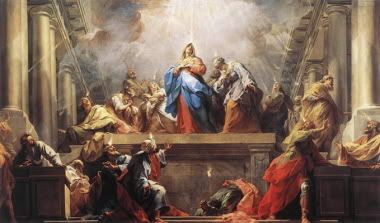
As it is also Mother’s Day, my mind is taken back to the image of the Virgin Mary, who is often pictured in the center of paintings of Pentecost (like the one above), awaiting with the disciples in the Upper Room, as Acts tells us, the promised outpouring of the Holy Spirit, signified in the tongues of fire illuminating their minds with God’s truth and in the miracle of languages to proclaim the Gospel.

May is the month of devotion to the blessed Virgin Mary. As Our Lady is called the Virgin Mother of God, so also is she looked upon as the Mother of those who find new life in the Savior she bore. She is likewise the first Christian, who heard the Word, responded in faith, carried Christ within her, followed him to the cross, and suffered along with him as he bore his passion. She is the Christian prototype.

As it is Mother’s Day, my mind is also drawn back to that famous quote from St Cyprian, Bishop of Carthage in Northern Africa. About AD 250, he asked rhetorically, “Can one have God as his Father, before one has had the Church for his Mother?”

Perhaps you remember the children’s book, Are you my Mother? by P.D. Eastman. It was a favorite of mine growing up, and I think it may help us to learn more about holy Mother Church today. If you have ever changed denominations or moved to a new city and looked around for a church, you can empathize with the bird’s search in this book: “Are you my mother?”
Photobucket
The story begins when an egg begins to twitch. The momma bird knows her egg will soon break and goes to find some food for her newborn. Sure enough, the egg hatches while she is away getting a worm. The baby bird stumbles out of the nest in search of his mother. He comes first to a kitten, then a hen, a dog, and a cow. “Are you my mother? Did I have a mother,” the baby bird thinks to himself. “I know I did. I will find her.” So he wanders on looking for mom.

He runs into an old car, a boat, and an airplane. But these are not his mother either. He then hops into the digging bucket of a backhoe. “Are you my mother?” The contraption lets out a “Snort!” and rumbles to life. The bird is caught in the rising arm of this crawler, being transported to some unknown destination.

Just when he thought he was about meet his end, the bucket dumps the bird back into his own nest in his own tree. And there is a creature who looks very much like himself and has a fresh meal waiting for his hungry belly. “Do you know who I am?” she said to the baby bird.

“Yes, I know who you are. You are not a kitten, a hen, a dog, or a cow,” he said. “You are not a car, a boat, a plane, or a snort. You are a bird, and you are my mother.” Once the little bird saw his mother, the contrast became quite obvious. None of these other things looked even remotely like his mother.

St John, to whom Jesus entrusted Mary as his mother at the cross, used this kind of high contrast in the Book of Revelation to illustrate the nature of our holy Mother Church. There is no confusing the Christ and the anti-Christ or the church and the world. The forces of evil are pictures as a seductively-clad harlot, full of abominations, drunk on the blood of the saints. She is the personified goddess Roma, riding on the back of the empire—the beast with seven imperial horns, trampling over the nations of the earth. Who could possibly confuse this with the Church, the spotless bride dressed in the purest linen, and a jewel-encrusted city with room for all coming down from heaven, the eternal home for the bride to share with Christ, her beloved husband.

“Are you my mother?” How do you know? What does the church look like? In confirmation class, we talk about the four “marks” of the church in the creed. The Church is "One, Holy, Catholic, and Apostolic." The Church is One (in spite of all our efforts to the contrary) because our Lord is one. Christ is not divided, and the church is his body, united to Christ as its one head.

The Church is Holy (despite all our shortcomings in the moral life) because it is the temple of the Holy Spirit. "Holy" Church is a way of saying that we are a community that belongs to God.

The Church is Catholic (which means we are Catholics) because we hold the faith together—that which has been believed “everywhere, always, and by all”—not because we hold some unique modern or American version of the faith. We could say that the local church only is the Church, insofar as it is the local manifestation of the Universal Church.

The Church is Apostolic, because it comes to us from the apostles themselves and carries on their apostolic zeal for the Gospel and witness to the risen Lord. “Are you my mother?” We remind ourselves each Sunday in the Nicene Creed what the Church (momma bird) is supposed to look like.

Of course, these are not the only attributes of the Church, though we must have those four. It is schismatic to depart from the Unity with Christ, the Holiness of life, the Catholicity of faith and the Apostolicity of ministry that God entrusted to his Church. These are non-negotiables.

On Pentecost, we are also reminded that the Church is a gifted community. When the Church was filled with the Holy Spirit, she immediately manifested the gifts that come with that empowerment. The first sign was the gift of tongues to spread the Gospel.

There are a myriad of spiritual gifts that God has imparted to his Church through the Holy Spirit. St Paul explains in today’s epistle, “To each is given the manifestation of the Spirit for the common good,” and he mentions some of these: wisdom, knowledge, words of faith, healing, miracles, prophecy, spiritual discernment, tongues and the interpretation of them. “All these are activated by one and the same Spirit,” he said, “who allots to each one individually just as the Spirit chooses.” We can also recognize Mother Church by the giftedness she has and her faithfulness in using spiritual gifts to build up the body of Christ.

Looking at that first Pentecost Sunday, we also note that the Church is missionary. Just before he ascended into heaven, Luke tells us that our blessed Lord told the disciples: “You will be my witnesses in Jerusalem (that is, at home), in Judea and Samaria (a little further out of your comfort zone), and to all the ends of the earth.”

The collect for the day reminds us of this central purpose of the Church: “Almighty God, on this day you opened the way of eternal life to every race and nation by the promised gift of your Holy Spirit: shed abroad this gift by the preaching of the Gospel, that it may reach to the ends of the earth . . .” My mother looks like a missionary. She is hard at work sharing the Gospel with people at home and with people abroad.

Another defining characteristic we see in holy Mother Church is the splendor of truth. In our Gospel today, Jesus said, “I will ask the Father, and he will give you another Advocate to be with you forever. This is the Spirit of truth, whom the world cannot receive, because it neither sees him nor knows him. You know him because he abides with you, and he will be in you.”

The Church receives truth from her Lord—the truth about God, about man, about sin and redemption, about the way of salvation—all these come from God. As the Holy Spirit imparts the gifts of knowledge, wisdom, and understanding, Jesus refers to him as the Spirit of truth who dwells in the Church. We find these revealed truths in the Bible (the written Word) and in the sacred tradition of the Church’s faith. The Holy Spirit guides us by reason into this truth.

“Are you my mother?” In his first letter to Timothy, St Paul described our mother as “the household of God, which is the church of the living God, the pillar and support of the truth.” (1 Tim 3:15)

Finally, we recognize Mother Church because of the love she shares. How did the baby bird in our story know he had found his mother? He found a creature that loved him, that was waiting with his first meal.

In our Gospel, Jesus said, “If you love me, keep my commandments.” At first that may sound a bit pretentious. But what does he mean by that? If we turn back to the previous chapter, we find the answer. Jesus said, “I am giving you a new commandment: love one another. Just as I have loved you, you are to love one another.”

We do this most fully by entering into the inexhaustible love of God. In his theology of the Trinity, St Augustine of Hippo described the third person of the Trinity as the Spirit of love—he is the love that binds the Son to the Father and the Father to the Son.

In the midst of perfect love, we find the bond of perfect unity. Remember that question from St Cyprian posed earlier about “Mother” Church? It came in his book On the Unity of the Catholic Church. After examining the nature and attributed of the church, he comes around to answering his own question. And he closes with a word of caution: “If you leave the Church of Christ, you will not come to Christ’s rewards. You will be an alien, an outcast, an enemy. You cannot have God for your Father unless you have the Church for your Mother.”

“Are you my mother?” My mother loves me, and I can see that she is totally, head-over-heels in love with Jesus, her husband. My mother believes the truth. My mother talks about it all the time, sharing the truth with the world, even to the ends of the earth. And my mother shows the gifts that she has, using them to strengthen our faith and build us up as a family.

You may have been looking for a mother like that, and if that’s the case, welcome home. Come celebrate with us, because it’s mom’s birthday and we’re having a party.

Thursday, May 15, 2008

How well do you know your Bible?


Melchior, Casper, and Balthasar--but that's not actually in the Bible.

Monday, May 12, 2008

The stork is on its way

Photobucket
My wife Melisa and I are happy to share the news that we are expecting our first child this November. "Children are a heritage from the Lord, and the fruit of the womb is a gift" (Psalm 127:3).

Why is everybody laughing?


It's too bad Obama's staff won't let him visit two of the most beautiful states in our great 60 state union.

Thursday, May 08, 2008

Turning down the red hat

Photobucket
I have heard mention several times of Archbishop William Laud being offered a cardinal's hat as a carrot to get him to become a Roman Catholic. Other than that, I don't know much of the story. Perhaps you could point me to more information. Here is the entry from his autobiography that mentions it:

[1633] August 4, Sunday. News came to Court the Lord Archbishop of Canterbury's death and the King resolved presently to give me, which he did, August 6.
August 4. That very morning at Greenwich there came one to me seriously and that avowed ability to perform it and offered me to be a Cardinal. I went presently to the King and acquainted hint both with the thing and the person
August 7, Wednesday. An absolute settlement between me and K.B. after I had made known my cause at large God bless me in it.
August 14, Wednesday. A report brought to me that I was poisoned.
August 17, Saturday. I had a serious offer made to me again to be a Cardinal. I was then from Court but so soon as I came thither (which was Wednesday, August 21), I acquainted his Majesty with it. But my answer again was that somewhat dwelt within me which would not suffer that till Rome were other than it is.
August 25, Sunday. My election to the Archbishopric was returned to the King then being at Woodstock.
Sept 19, Thursday. I was translated to the Archbishopric of Canterbury.

Tuesday, May 06, 2008

Parish Picnic at River Legacy Park

Photobucket
Photobucket
Photobucket
Photobucket
Photobucket
Photobucket
Photobucket
Photobucket
Special thanks to parishioners Weldon Waln and Meredith Killingsworth for sharing some of their pictures.

Also, here is that Old Testament story I talked about in the homily.

2 Kings 2:1-15
When the LORD was about to take Elijah up to heaven in a whirlwind, Elijah and Elisha were on their way from Gilgal. Elijah said to Elisha, "Stay here; the LORD has sent me to Bethel." But Elisha said, "As surely as the LORD lives and as you live, I will not leave you." So they went down to Bethel. The company of the prophets at Bethel came out to Elisha and asked, "Do you know that the LORD is going to take your master from you today?" "Yes, I know," Elisha replied, "but do not speak of it." Then Elijah said to him, "Stay here, Elisha; the LORD has sent me to Jericho." And he replied, "As surely as the LORD lives and as you live, I will not leave you." So they went to Jericho. The company of the prophets at Jericho went up to Elisha and asked him, "Do you know that the LORD is going to take your master from you today?" "Yes, I know," he replied, "but do not speak of it." Then Elijah said to him, "Stay here; the LORD has sent me to the Jordan." And he replied, "As surely as the LORD lives and as you live, I will not leave you." So the two of them walked on. Fifty men of the company of the prophets went and stood at a distance, facing the place where Elijah and Elisha had stopped at the Jordan. Elijah took his cloak, rolled it up and struck the water with it. The water divided to the right and to the left, and the two of them crossed over on dry ground. When they had crossed, Elijah said to Elisha, "Tell me, what can I do for you before I am taken from you?" "Let me inherit a double portion of your spirit," Elisha replied. "You have asked a difficult thing," Elijah said, "yet if you see me when I am taken from you, it will be yours—otherwise not." As they were walking along and talking together, suddenly a chariot of fire and horses of fire appeared and separated the two of them, and Elijah went up to heaven in a whirlwind. Elisha saw this and cried out, "My father! My father! The chariots and horsemen of Israel!" And Elisha saw him no more. Then he took hold of his own clothes and tore them apart. He picked up the cloak that had fallen from Elijah and went back and stood on the bank of the Jordan. Then he took the cloak that had fallen from him and struck the water with it. "Where now is the LORD, the God of Elijah?" he asked. When he struck the water, it divided to the right and to the left, and he crossed over. The company of the prophets from Jericho, who were watching, said, "The spirit of Elijah is resting on Elisha." And they went to meet him and bowed to the ground before him.

Saturday, May 03, 2008

Together for the sake of the Gospel

Amos 3:3
"Can two walk together, without being in agreement?"
Photobucket
The Most Rev'd Gregory Venables, Primate of the Southern Cone, (pictured left) visited with Bishop Iker and the clergy of the diocese yesterday. It was a joy to welcome his presence among us and experience a true fellowship in the Gospel. He will be visiting with the people of the diocese this Saturday and Sunday. I thank him for his graciousness, love, and concern. It is wonderful to know that we have friends on the front lines of Christian mission all the way to Cape Horn.

Reports: Fr Randall Foster from the cathedral has a nice and very appreciative summary, "Venables in Diocese of Fort Worth." For a picture behind the scenes, take a look at Pat Salazar's account, "Bonnell's, Buffalo, and the Archbishop." For sarcasm and ridicule, don't forget to check out Katie Sherrod's entry, "Jesus loves me but he's not so sure about you."

Steering Committee Drops F-Bomb on Venables: In their press release, the Steering Committee (which aims to be the unelected TEC replacement standing committee come November, as far as I can gather) noted: "Venables graciously and ably presented the fundamentalist case for a literal interpretation of selected scripture. He also continued to misstate the position of our presiding bishop and the Episcopal Church regarding the role of Christ in salvation and characterized Christianity as an 'intolerant' faith." Given some of the people I know on the committee who should know better, I was surprised that they seem to think that any Christian who is not an outright revisionist must be a fundamentalist. To me, that seems pretty clueless. Perhaps it is just an attempt to return the favor to those who have used "the R-word" about them.

Audio: To listen to Archbishop Venables at St John's in Vancouver, click here. More audio should be accessible soon.

Video: Below is a video from Anglican TV of Archbishop Venables conducting a seminar on Anglicanism as well as his recent sermon from St James Cathedral in Fresno.


Video: Below are two short clips from Fr Cantrell of Archbishop Venables' presentation at St Vincent's Cathedral School in Beford. The first is on Jesus and the second is on the Word of God.

A telling comparison?

Someone who used to attend St Alban's recently pointed to the question of how Scripture is used on the websites of the Episcopal Church and of the Episcopal Diocese of Forth Worth. The diocesan site, fwepiscopal.org (pictured below), begins with a page of Scripture from the New Testament. If you click on it (or wait awhile), it will take you to the index page where you will discover that the Scripture verse you clicked on to enter (Ephesians 4:12) is also the mission statement of our diocese. There is no doubt what we believe in and what we are all about.
Photobucket
Photobucket
If you go to the Episcopal Church website, episcopalchurch.org (pictured above), you first find the motto: "The Episcopal Church welcomes you." On the front page (I love the layout, by the way), you'll find an alternating parishioner picture, links to information about the church, links to church news, and links to church websites. Church, church, church, church, church. There is no doubt what we believe in and what we are all about.

But except for what might be included in the news headlines at the time, what you will not find is any Scripture, nor of a mention of "God," "Christ," or "Jesus." Is it a telling comparison? Perhaps. I would say that's a bit of a stretch, that it is certainly not anything conclusive. But it is important to ask the questions: How are we seen? What looks most important to us in the eyes of others? What is our witness? I think we can always do more to direct attention to our Lord and less to ourselves.

Thursday, May 01, 2008

Crucifixion or the Ascension?

I have been intrigued recently on the passages from the Gospel of John which take place in the Upper Room at the time of the Last Supper. What is interesting is the context and the content of Jesus' words. While the context is the night before the crucifixion, the content has often been used (including in the liturgy) as text about the risen Christ ascending into heaven.

John's gospel is different in many ways. He does not give us the familiar narratives of the Last Supper nor of the Ascension. Instead, the second part of his gospel, often called the "Book of Glory," focuses on the crucifixion (the supreme moment of Jesus' glorification) and the resurrection (the epiphany of Jesus' glory). Some scholars have suggested that the prayer of Jesus before the crucifixion has post-resurrection material read back into it. Of course, Jesus could have prayed this basic prayer every night with his disciples. The thing to recognize is that many passages from the crucifixion context "work" in the context of the ascension, which says something about the glory of both. For example:

13:3 Jesus, knowing that the Father had given all things into his hands, and that he had come from God and was going back to God...

13:19 I am telling you this now, before it takes place, that when it does take place you may believe that I AM.

13:31-33 Now is the Son of Man glorified, and God is glorified in him. If God is glorified in him, God will also glorify him in himself, and glorify him at once. Little children, yet a little while I am with you. You will seek me, and just as I said to the Jews, so now I also say to you, 'Where I am going you cannot come.'

14:1-12 "Let not your hearts be troubled. Believe in God; believe also in me. In my Father’s house are many rooms. If it were not so, would I have told you that I go to prepare a place for you? And if I go and prepare a place for you, I will come again and will take you to myself, that where I am you may be also. And you know the way to where I am going." Thomas said to him, "Lord, we do not know where you are going. How can we know the way?" Jesus said to him, "I am the way, and the truth, and the life. No one comes to the Father except through me. If you had known me, you would have known my Father also. From now on you do know him and have seen him." Philip said to him, "Lord, show us the Father, and it is enough for us." Jesus said to him, "Have I been with you so long, and you still do not know me, Philip? Whoever has seen me has seen the Father. How can you say, 'Show us the Father'? Do you not believe that I am in the Father and the Father is in me? The words that I say to you I do not speak on my own authority, but the Father who dwells in me does his works. Believe me that I am in the Father and the Father is in me, or else believe on account of the works themselves. Truly, truly, I say to you, whoever believes in me will also do the works that I do; and greater works than these will he do, because I am going to the Father."

14:15-20 "If you love me, you will keep my commandments. And I will ask the Father, and he will give you another Helper, to be with you forever, even the Spirit of truth, whom the world cannot receive, because it neither sees him nor knows him. You know him, for he dwells with you and will be in you. I will not leave you as orphans; I will come to you. Yet a little while and the world will see me no more, but you will see me. Because I live, you also will live. In that day you will know that I am in my Father, and you in me, and I in you."

16:7-8 Nevertheless, I tell you the truth: it is to your advantage that I go away, for if I do not go away, the Helper will not come to you. But if I go, I will send him to you. And when he comes, he will convict the world concerning sin and righteousness and judgment...

16:28 I came from the Father and have come into the world, and now I am leaving the world and going to the Father.

17:4-5 I glorified you on earth, having accomplished the work that you gave me to do. And now, Father, glorify me in your own presence with the glory that I had with you before the world existed.

17:11-15 And I am no longer in the world, but they are in the world, and I am coming to you. Holy Father, keep them in your name, which you have given me, that they may be one, even as we are one. While I was with them, I kept them in your name, which you have given me. I have guarded them, and not one of them has been lost except the son of destruction, that the Scripture might be fulfilled. But now I am coming to you, and these things I speak in the world, that they may have my joy fulfilled in themselves. I have given them your word, and the world has hated them because they are not of the world, just as I am not of the world. I do not ask that you take them out of the world, but that you keep them from the evil one.

17:24 Father, I desire that they also, whom you have given me, may be with me where I am, to see my glory that you have given me because you loved me before the foundation of the world.

Wednesday, April 23, 2008

And now I'm 33 years old

Photobucket
My birthday was on Monday, April 21st (Feast of St Anselm of Canterbury). I don't usually mention birthdays to others, partly because I'd feel like I'm soliciting gifts and partly because its frankly not such a big deal once you leave the nest. But this one has held a special fascination for me since I was turning 33, which is the age that tradition tells us Jesus was when he died on the cross.

I'm not sure what spiritual insight may come from this, but it has been on my mind. Here are some of the things I've noticed so far, now that I am the same age.

The first thing that occurred to me is that the Jesus I see depicted on the cross in paintings, icons, and sculpture seems a bit younger than 33 to me. He often looks more like 25 or even younger. I'm sure that part of it is the fact that he would naturally be more fit than I am, having to walk all the time and probably having a much healthier diet. But still, he usually looks younger to me. The depictions of Jesus in some Eastern icons in the Pantokrator style seem closer to the actual age. It is an older Jesus who should be depicted on the cross.

The second thing that occurred to me is that it is about this age when one one begins to notice that the body will eventually wear out. It's not that you feel old, but just that you become aware of the aging process--not as "growing up," but as "growing old." Depending upon the person, you may have a little gray here or there (I've never seen Jesus with any gray hair, but I suspect he had some). You also notice from time to time that there are some things you just couldn't do like you used to--a little more chubby, a little less agile, a few gray hairs, a wrinkle here and there, a twinge in the back, an ache in the knee, etc. This is the kind of body that was nailed on the cross.

The third thing that occurred to me is that with that growing awareness that you aren't a kid anymore, you loose that feeling of invincibility that comes with youth. Every now and then, you are given a moment of pause that you would not have had earlier. More and more, your thoughts turn to long-term and middle-aged concerns. One might expect this departing sense of youthful vigor and invincibility to leave one feeling run-down and debilitated, but this is far from the case. Youthful vigor is replaced with endurance and wisdom. Invincibility is replaced with the strength of moral courage. This is the Jesus who was nailed to the cross and bore the sins of the world.

Tuesday, April 15, 2008

Guardians, encouragers, examples to the flock

Photobucket
Click here to listen to my sermon from 13 April 2008.

Jesus Christ is now alive. He has risen from the dead. And he appearing numerous times to many people over a period of forty days, when, in the sight of many, he ascended into heaven. The Bible tells us he has taken a position of honor and authority there—that he is “seated at the right hand of the Father” until he returns in glory. But let’s not let the metaphorical language about “being seated” be misleading in leading us to think that there is anything passive about Jesus’ life and ministry to this very day. Indeed, if you think back with me, you will notice that the scripture lessons since Easter Sunday have been talking about ways in which Jesus is now living and active in his church.

First, we heard the story of doubting Thomas in which Jesus appeared to the apostles, breathed on them, and said, “Receive the Holy Spirit. Whose sins you forgive are forgiven, and whose sins you retain are retained.” Jesus is still absolving people from their sins through his ministers. And secondly, last Sunday we heard the story of Jesus appearing to two disciples along the road to Emmaus. He led them in a very enlightening Bible study and then at supper, he was made known to them in the breaking of bread. Jesus is still among us in his proclamation of the Scriptures and through the blessed sacrament of his Body and Blood.

Today, which has often been called, Good Shepherd Sunday, we are reminded that Jesus is still ministering to us through his appointed shepherds. Now there are several ways that Jesus shepherds his people in his church, but chief among them is through his ordained shepherds, the bishops. As the church spread in those early days, Apostles would ordain elders in the local churches and leave one of them in charge. That is, the apostle would appoint one of the elders in the local church to be his apostolic successor as overseer (or “bishop”) of the flock. We see this intimate identification of bishops and shepherds in Peter’s letter, “you have now returned to the mena kai episcopon—the shepherd and bishop of your souls.”

You might have recognized in the verse there the word episcopon or episcopos as the Greek source of the name of our church, the “Episcopal Church.” Now it is kind of strange to say THE Episcopal Church as if we were the only one for there are seven other Episcopal Churches in the Anglican communion. Incidentally, 15 use the name “Anglican”, 3 use the name “Catholic” and 19 use no description in their official name at all (e.g. Church of England, Church of the Province of the Indian Ocean).

What is an episcopal church? It is any church with an Episcopal structure or polity, a church gathered around an episcopos—an “overseer” or “bishop”. Of course, that means there are all kinds of non-Anglican episcopal churches. The Russian Orthodox Church, the Roman Catholic Church, and the Lutheran Church of Sweden are all episcopal churches. They are congregational families gathered around a bishop—like the patriarch of a clan. This has been the pattern in the church from the earliest days.

From St Ignatius, who followed St Peter as bishop of Antioch, we read, “Wherever the bishop appears, let the congregation gather. Just as, wherever Jesus Christ is, there is the Catholic Church.” St Cyprian, bishop of Carthage in Northern Africa wrote about 150 years later, “You should know that the bishop is in the church, and the church is in the bishop. If anyone is not with the bishop, he is not in the church.” And in the next century, an early church manual, the Apostolic Constitutions, noted: “As to a good shepherd, let the layman honor him, love him, and reverence him as his leader, his high priest of God, and as a teacher of piety. For he that hears him, hears Christ, and he that rejects him, rejects Christ.”

The Bishop is a representative or vicar of Jesus Christ, the Good Shepherd. In today’s readings, I see three tasks of a shepherd in the church of God. As we read in today’s gospel, Jesus reminds us that the first responsibility of any shepherd is to guard and protect the flock. A shepherd is a provider, a protector, a source of strength and encouragement. “Though I walk through the valley of the shadow of death, I will fear no evil. For you are with me; your rod and your staff, they comfort me.” The bishop carries a shepherds staff as a reminder that he is to gently guide the flock and also chase away the wolves.

Jesus said that a shepherd “calls his own sheep by name and leads them out. When he has brought out all his own, he goes ahead of them, and the sheep follow him because they know his voice.” The shepherd has to ensure that there are safe, green pastures for the flock to graze. If the pasture becomes barren or dangerous, he leads them to a new pasture. The shepherd watches out for the wolves in sheep’s clothing who bark out half-truths and false doctrine to scatter the flock.

It is no wonder that in Paul’s letter to Titus (1:9), we read, “Since a bishop is entrusted with God’s work . . . He must hold firmly to the trustworthy message as it has been taught, so that he can encourage others by sound doctrine and refute those who oppose it.” The historic Anglican ordinal picked up on that language, with the new bishop vowing to banish all error in doctrine.

“The thief comes only to steal, to kill, and destroy,” Jesus said. “I came that they might have life, and have it abundantly.” The role of guardian stands out as a chief responsibility for successors to the apostles. In the 1979 Prayer Book, we read, “A bishop in God’s holy Church is called to be one with the apostles in proclaiming Christ’s resurrection and interpreting the Gospel, and to testify to Christ’s sovereignty as Lord of lords and King of kings. You are called to guard the faith, unity, and discipline of the Church.” At the creed, the theme continues, “We call upon you, chosen to be a guardian of the Church’s faith, to lead us in confessing that faith.” Notice how the NRSV translates episcopon in today’s epistle as “guardian.”

In addition to being a guardian, a bishop is to be an encourager and provider, so that not only will the flock be safe, but they will be able to grow together. And one way that a shepherd provides for the flock is to encourage each member of the flock to take an active role in their common life.

This is what we see going on in our first reading, from the book of Acts. In this passage, the apostles sense a need for someone to care for the widows. They make a strategic decision; rather than stretch themselves thin, they decide to ordain deacons. “Select from among yourselves seven men of good standing, full of the Spirit and of wisdom, whom we may appoint to this task, while we, for our part, will devote ourselves to prayer and to serving the Word.” From the very beginning, we see that the role of the overseer is to be an involver and encourager of the brethren, not unlike the way Jesus went about doing things.

The ordination rite for a bishop in the Prayer Book expressed it well. The bishop-elect is asked, “As a chief priest and pastor, will you encourage and support all baptized people in their gifts and ministries, nourish them from the riches of God’s grace, pray for them without ceasing, and celebrate with them the sacraments of our redemption?” Notice how the response is worded. The bishop-elect replies, “I will, in the name of Christ, the Shepherd and Bishop of our souls.”

Guardian, encourager, and let us not forget, example. A shepherd is an example to the flock. This is how he is to exercise leadership. What the bishop should exemplify above all is the selfless love of Christ. St Peter wrote in his first letter, “Christ also suffered for you, leaving you an example, so that you should follow in his steps.”

It was cold and dark that day in 1012 in Greenwich. Danish invaders wandered around the camp where the archbishop of Canterbury was held in chains. Things were not going their way. They had captured the poor monk at Canterbury, when the city was seized. But their prize had not paid off. And they were tired of waiting.

They needed funds—for food, supplies, for mercenaries. They had sent word to his flock—their bishop Alphege was being held for ransom, but this bishop was not paying off. The hours wandered on. A cold drizzle began as Easter week in England drew to a close. The Vikings started drinking and complaining. But then word came from Canterbury—the Christians there, burdened by poverty and war were not willing to pay the ransom.

They were not willing, only because Alphege himself had ordered them not to. The Vikings broke out in a riot. This English monk had foiled their plan. Cries went out in the camp for to get rid of the bishop. But another warrior in the camp raised his voice on behalf of their captured cleric.

One of the Viking commanders, Thorkell the Tall, tried to save this Christian. The commander offered most of his own possessions to pay the ransom. Evidently Alphege had made his impression on this Viking, for not only was Thorkell moved to save him, but like Alphege, he was unwilling to deprive his own people in the process.

The offer was declined. The drunken Danes were no longer interested in money. The warriors wanted revenge for this great insult. The mob began to pelt him with bones, until one of them smote Alphege on the head with an axe, and he fell dead to the ground. The Church celebrates the feast of Alphege on next Saturday, April 19th. And when I heard the story, I said to myself, Now that is a bishop; that is a shepherd. For like the Good Shepherd, Alphege laid down his life for the sheep. A Good Shepherd knows that the sheep come first.

Guardians, encouragers, examples to the flock. Today we give thanks that the risen Lord is living and active among us in so many ways, but most especially in the shepherds he has provided to guard, encourage, and be examples to the flock. God entrusted us to them as his own people, to lead us through Jesus Christ, the gate of the sheep, to eternal heavenly pastures. Thank you, Lord, for faithful shepherds.

Rector's Forum

Photobucket
The Rector held a forum last Sunday on the recent House of Bishops meeting and the attempted depositions of Bishops Schofield and Cox. You can listen to the audio here.

Below are some relevant background materials: the applicable canons and articles including Conger's Living Church article first noting the irregularity. Also, some parishioners asked about resources to stay informed. Please take note of the "Church News and Comment" links near the top of the right hand column on this blog.

TITLE IV, CANON 9: Of Abandonment of the Communion of This Church by a Bishop

Sec. 1. If a Bishop abandons the communion of this Church (i) by an open renunciation of the Doctrine, Discipline, or Worship of this Church, or (ii) by formal admission into any religious body not in communion with the same, or (iii) by exercising episcopal acts in and for a religious body other than this Church or another Church in communion with this Church, so as to extend to such body Holy Orders as this Church holds them, or to administer on behalf of such religious body Confirmation without the express consent and commission of the proper authority in this Church; it shall be the duty of the Review Committee, by a majority vote of All the Members, to certify the fact to the Presiding Bishop and with the certificate to send a statement of the acts or declarations which show such abandonment, which certificate and statement shall be recorded by the Presiding Bishop. The Presiding Bishop, with the consent of the three senior Bishops having jurisdiction in this Church, shall then inhibit the said Bishop until such time as the House of Bishops shall investigate the matter and act thereon. During the period of Inhibition, the Bishop shall not perform any episcopal, ministerial or canonical acts, except as relate to the administration of the temporal affairs of the Diocese of which the Bishop holds jurisdiction or in which the Bishop is then serving.

Sec. 2. The Presiding Bishop, or the presiding officer, shall forthwith give notice to the Bishop of the certification and Inhibition. Unless the inhibited Bishop, within two months, makes declaration by a written statement to the Presiding Bishop, that the facts alleged in the certificate are false or utilizes the provisions of Canon IV.8 or Canon III.12.7, as applicable, the Bishop will be liable to Deposition. If the Presiding Bishop is reasonably satisfied that the statement constitutes (i) a good faith retraction of the declarations or acts relied upon in the certification to the Presiding Bishop or (ii) a good faith denial that the Bishop made the declarations or committed the acts relied upon in the certificate, the Presiding Bishop, with the advice and consent of a majority of the three senior Bishops consenting to Inhibition, terminate the Inhibition. Otherwise, it shall be the duty of the Presiding Bishop to present the matter to the House of Bishops at the next regular or special meeting of the House. If the House, by a majority of the whole number of Bishops entitled to vote, shall give its consent, the Presiding Bishop shall depose the Bishop from the Ministry, and pronounce and record in the presence of two or more Bishops that the Bishop has been so deposed.
Photobucket

Deposition Votes Failed to Achieve Canonically Required Majority
March 15, 2008, by George Conger

Slightly more than one-third of all bishops eligible voted to depose bishops John-David Schofield and William J. Cox during the House of Bishops’ spring retreat, far fewer than the 51 percent required by the canons.

The exact number is impossible to know, because both resolutions were approved by voice vote. Only 131 bishops registered for the meeting March 7-12 at Camp Allen, and at least 15 of them left before the business session began on Wednesday. There were 294 members of the House of Bishops entitled to vote on March 12.

When questioned about canonical inconsistencies during a telephone press conference at the conclusion of the meeting, Bishop Michael Curry of North Carolina said the bishops had relied on advice provided to them by canonical experts, and did not examine canonical procedure during plenary debate prior to the votes to depose bishops Schofield and Cox.

Bishop Schofield was consecrated Bishop of San Joaquin in 1989. Last December, he presided over a diocesan convention at which clergy and lay delegates voted overwhelmingly to leave The Episcopal Church and affiliate with the Anglican Church of the Southern Cone. Bishop Cox was consecrated Bishop Suffragan of Maryland in 1972. He resigned in 1980, later serving as Assisting Bishop of Oklahoma from 1980 to 1988. In 2005, Bishop Cox ordained two priests and a deacon at Christ Church, Overland Park, Kan. Christ Church affiliated with the Anglican Church of Uganda after purchasing its property from the Diocese of Kansas.

Both bishops were charged with abandonment of communion. The procedure for deposing a bishop under this charge is specified in Title IV, canon 9, sections 1-2. The canon stipulates that the vote requires “a majority of the whole number of bishops entitled to vote,” not merely a majority of those present. At least a dozen bishops voted either not to depose Bishop Schofield or to abstain, according to several bishops. The number voting in favor of deposing Bishop Cox was reportedly slightly larger than the number in favor of deposing Bishop Schofield.

Presiding Bishop Katharine Jefferts Schori was questioned about the history of the canonical proceedings against Bishop Cox. At first she said during the press conference that she had not sought the canonically required consent of the three senior bishops of the church for permission to inhibit Bishop Cox pending his trial. However Title IV, Canon 9, sections 1-2 do not describe a procedure for deposing a bishop who has not first been inhibited.

Consent Never Sought

Later in the press conference, Bishop Jefferts Schori clarified and extended her remarks, saying she had been “unable to get the consent of the three senior bishops last spring. That’s why we didn’t bring it to the September meeting” of the House of Bishops. One of the three senior bishops with jurisdiction confirmed to The Living Church that his consent to inhibit Bishop Cox was never sought.

In 2007, Bishop Cox sent a written letter to Bishop Jefferts Schori, announcing his resignation from the House of Bishops. Since he was already retired, he did not have jurisdiction, and therefore unlike Bishop Schofield, his resignation did not require consent from a majority of the House of Bishops. A trial of the 88-year-old retired bishop was not mandatory.

Bishop Cox also does not appear to have been granted due process with respect to a speedy trial. Once the disciplinary review committee formally certifies that a bishop has abandoned communion, the canons state “it shall be the duty of the Presiding Bishop to present the matter to the House of Bishops at the next regular or special meeting of the house.” The review committee provided certification to Bishop Jefferts Schori on May 29, 2007. His case should have been heard during the fall meeting in New Orleans last September. When asked about the apparent inconsistency, Bishop Jefferts Schori said initially she did not include Bishop Cox’s case on the agenda for the New Orleans meeting “due to the press of business.”

Title IV, canon 9, section 1 requires the Presiding Bishop to inform the accused bishop “forthwith,” in other words immediately, after the review committee has provided a certificate of abandonment, but Bishop Jefferts Schori did not write to Bishop Cox until Jan. 8, 2008, more than seven months afterward.

The two-hour business session at which the deposition votes were taken ran slightly longer than originally scheduled. First a resolution was read followed by prayer from the chaplain. A period of silence followed the prayer. After the silence was broken, the bishops discussed the resolution in small table groups followed by plenary discussion. When it appeared that everyone who wanted to speak had done so, the voice vote was taken. Each resolution was read and voted on separately.


Call for review after trial ‘flouted Church rules’
March 27, 2008, by George Conger

US Presiding Bishop Katharine Jefferts Schori failed to follow the procedural rules governing the trial of Bishop William Cox for “abandonment of the Communion” of the Episcopal Church an investigation by The Church of England Newspaper has found.

In a March 12 press conference, Bishop Schori stated she had not followed rules governing the requirement that the 88-year old retired bishop be granted a speedy trial, that he be informed of the charges against him in a timely fashion, and that the consent of the church’s senior bishops be solicited by the Presiding Bishop to suspend him from office pending trial. A subsequent investigation by CEN in conjunction with The Living Church magazine revealed an insufficient number of votes to convict were cast also.

The Bishop of Central Florida has called for a review of the proceedings, and the president of the church’s appellate court of review for the trial of bishops is understood to have agreed to look into the proceedings.

Elected suffragan bishop of Maryland in 1972, Bishop Cox was translated to Oklahoma in 1980 as assistant bishop and retired in 1988. In June 2005, Bishop Cox performed ordinations at Christ Church, Overland Park, Kansas on behalf of Archbishop Henry Orombi of Uganda. Earlier that year Christ Church negotiated an amicable parting of the ways with the diocese of Kansas and had joined the Ugandan Church. Bishop Cox returned the following month to Overland Park to perform confirmations on behalf of Archbishop Orombi.

The bishops of Kansas and Oklahoma filed a complaint against Bishop Cox for performing Episcopal acts without the permission of the local diocesan bishop. In March 2006 the Church’s Title IV review committee found there was sufficient evidence to bring Bishop Cox to trial, however, Presiding Bishop Frank Griswold declined to prosecute.

Following the 2006 election of Bishop Katharine Jefferts Schori as Presiding Bishop the charges were resubmitted. Bishop Cox, then 87 years of age, declined to contest the matter telling his attorney he was too old to fight, and by letter resigned his membership in the House of Bishops on March 28, 2007.

In his letter of resignation Bishop Cox said that although he was resigning his membership in the House of Bishops and was not resigning his orders and would be joining the Province of the Southern Cone and would continue his episcopal ministry in that branch of the Communion.

Bishop Schori forwarded the letter to the Title IV review committee asking it to determine whether by this letter, Bishop Cox had “abandoned the communion” of the Episcopal Church.

On May 29, 2007 the Title IV review committee issued its certificate and report under Title IV Canon 9 that Bishop Cox had “abandoned the communion.” On Jan 8, 2008 she informed Bishop Cox that he had been determined to have abandoned the communion of this church. She gave him 60 days to recant, or else he would be brought before the next house of bishops meeting and be deposed. Offering no defence, Bishop Cox was deposed on a voice vote of bishops attending the final day of the meeting.

The procedures laid out in Title IV, Canon 9, sections 1 and 2 (the abandonment canon) to depose a bishop state that after the Title IV review committee issues a certificate of abandonment the Presiding Bishop “shall” “forthwith” notify the accused. The Presiding Bishop then “shall” seek the consent of the three senior bishops with jurisdiction to inhibit the accused bishop, and trial “shall” take place at the “next” meeting of the House of Bishops.

At a March 12 press conference Bishop Schori outlined the procedural history surrounding the Cox case. She said the Title IV review committee had “certified [Bishop Cox] several years ago. … before her time.” She added, however, that “it was never brought to the House of Bishops for action.”

She then said she “did not send it to the three senior bishops” and the House of Bishops “did not consider it in September” at their meeting in New Orleans with the Archbishop of Canterbury due to the “the press of other business.”

Several minutes later, Bishop Schori said she wanted to “clarify” her earlier statements. She said she had been “unable to get the consent of the three senior bishops last spring. That’s why we didn’t bring it to the September meeting” of the House of Bishops.

Contacted after the press conference, one of the three senior bishops, who declined to be named, stated he had never been asked by Bishop Schori to consent to Bishop Cox’s supension.

The Presiding Bishop’s Chancellor, Mr. David Booth Beers, declined to address the issues surrounding Bishop Cox’s case in a March 15 statement released through the Episcopal Church’s press office. However, he stated that his “position” was that there had been a legal quorum to depose the two bishops on March 12.

Canon lawyer, retired Bishop William Wantland of Eau Claire told CEN the deposition of Bishop Cox was “void” for failing to achieve the required “majority vote of all bishops entitled to vote” and because the “canonical procedure was simply not followed.”

In defence of the proceedings against Bishop Cox, Indianapolis Bishop Catherine Waynick wrote that while the “canons may need to be clarified, what does not seem to need clarifying” was that “William Cox willfully violated the canons by functioning where he had been specifically asked not to.”

However, the charge brought against Bishop Cox was not violating diocesan boundaries. In 2006 Bishop Griswold dropped the charges proffered against Bishop Cox for the Kansas ordination, raising the question whether the bishops convicted him of a crime not before the bishops for adjudication.

The charge was “Abandonment of Communion,” Bishop Wantland said. The punishment for violation of diocesan boundaries “is a totally different charge. In my opinion, this is what he should have been charged with, and the procedure under Canon IV. 9. 2 was totally inappropriate and without any justification,” he said.

On March 15, Central Florida Bishop John W. Howe urged the Episcopal Church’s three senior bishops to review the case, saying he was under “no illusions that the outcome of the despicable vote to depose John-David [Schofield] and William [Cox] will be reversed, but at least we might want to obey the canons.”

On Maundy Thursday, Bishop Howe repeated his call for justice to those falsely condemned, noting “I recall that another person of influence washed his hands of a difficult matter on this same weekend some years ago.”


Bishops demand to know litigation costs
March 31, 2008, by George Conger

Two retired American bishops have called upon the national church in New York to disclose the amount of money the Episcopal Church is spending on litigation with breakaway congregations.

The call for financial accountability from retired Bishops Williams Wantland of Eau Claire, Wisconsin and Bishop Maurice Benitez of Texas comes amidst tightening finances for the Episcopal Church, which has also announced it would no longer pay the stipends of overseas missionaries.

On March 7, the Episcopal Church’s mission personnel officer announced that missionaries sponsored by the national church would no longer receive stipends or reimbursement for travel expenses.

Lay missionaries would now receive the same pension benefits as ordained missionaries. However, this rise in costs plus increased health and conference fees coupled with a “reduction in our overall budget of 5 percent in 2008 due to budget constraints” had forced the church to cut off missionary stipends.

The cuts will take immediate effect for new missionaries, while those on current assignment will see the change when their “Letters of Understanding” are renewed.

The suspension of the stipendiary missionary programme follows a Feb 29 open letter from the two retired bishops seeking an accounting for the estimated several million dollars spent on litigation by the national church offices. The two bishops wrote their latest request was their third attempt to get an answer.

The first answer the bishops received, they said, was that the money spent on lawyers to fight the church’s property battles was “a secret.” A second request elicited the response that “no funds for litigation have come from either the Pension Fund or Trust Funds. However, [the national church] refused to disclose the amounts being expended on litigation.”

In their Feb 29 letter, the bishops stated the national church had no legal right to withhold financial information. Saying “it’s a secret” was “not acceptable. If there is nothing wrong with these expenditures, then why do you refuse to reveal the amount?” Bishops Wantland and Benitez asked.


Presiding Bishop charged with defaming Bishop Cox
April 2, 2008, by George Conger

Lawyers for the octogenarian bishop deposed by the American Church have written to Presiding Bishop Katharine Jefferts Schori charging her with defaming their client.

Questions over the legality of the March 12 proceedings have riled the American Church since the legality of the decision to depose Bishop John-David Schofield of San Joaquin and retired Bishop William Cox was questioned by The Church of England Newspaper and the Living Church.

On March 27 the Diocese of South Carolina issued a formal protest to the “failure to follow the Canons” and asked Bishop Schori to “revisit those decisions”, “refrain” from appointing a new bishop for San Joaquin and to “make every effort to follow our Church Canons in all future House of Bishops decisions.”

“Because we feel so strongly that the Canons were not followed in the depositions of Bishops Schofield and Cox, we must respectfully refuse to recognize the depositions, and we will not recognize any new bishop who may be elected to replace Bishop Schofield, unless and until the canons are followed,” South Carolina said.

The Bishop of Central Florida last week called for a review of the decision, raising the matter with Bishop Clifton Daniels III of East Carolina, the president of the church’s court of review for the trial of a bishop. Though Bishop Daniels declined to respond to a query from the CEN, he is understood to have agreed to look into the matter.

R. Wicks Stephens, the chancellor of the Anglican Communion Network and attorney for Bishop Cox wrote to Bishop Schori and her lawyer David Booth Beers on March 27 stating “your purported deposition of Bishop Cox is unsupported by the canonically required consent of a majority of the whole number of Bishops entitled to vote on the proposed deposition of Bishop Cox which was presented to the House of Bishops at its last meeting. Accordingly, the deposition of Bishop Cox was not consented to as required, and your pronouncement of his deposition as a Bishop is without effect and void.”

He lambasted Mr. Beers’ argument that his “reading” of the canons required “merely the consent of a majority of those Bishops present in the House” to depose the two bishops, citing the text of the constitution and canons to support this reading.

“While assuredly your Chancellor has the right to offer interpretations of the canons when ambiguity so requires, nothing justifies a reading” of the canons “that is directly contrary to that canon’s plain language and meaning,” Mr. Stephens said, demanding that “you right the wrong by which you have defamed Bishop Cox by immediately withdrawing your pronouncement of deposition.”


Letter to the San Joaquin Standing Committee
The following is the letter sent to the elected members of the Standing Committee of San Joaquin, but without the addresses of each member (which were amazingly included in the original as posted to Episcopal News Service).

January 25, 2008

The Very Rev. Canon James L. Snell
The Rev. Richard I. James
Ms. Kim Robinson
Mr. Ted Yumoto
The Rev. Michael E. McClenaghan
The Rev. Robert G. Eaton
Mr. Tom Wright
Mr. Stevie Oates

Dear Sirs and Madam,

I am writing to you because I have been informed that you constituted the Standing Committee of the Episcopal Diocese of San Joaquin prior to and/or during the most recent Convention of the Diocese in December 2007. It has come to my attention that in the past several months you have taken actions in support of an attempt to take the Episcopal Diocese of San Joaquin out of the Episcopal Church and into affiliation with the Province of the Southern Cone. I understand that these have included voting to amend the Diocese’s Constitution and canons and attempting to organize as the Standing Committee of an entity that identifies itself as an Anglican Diocese of the Province of the Southern Cone. These actions directly conflict with the Constitution and canons of the Episcopal Church.

Canon I.17.8 of the Episcopal Church provides that “[a]ny person accepting any office in this Church shall well and faithfully perform the duties of that office in accordance with the Constitution and Canons of this Church and of the Diocese in which the office is being exercised.” In the light of your recent actions, I find that you have been and are unable to well and faithfully fulfill your duties as members of the Standing Committee of the Episcopal Diocese of San Joaquin under Canon I.17.8. Accordingly, with this letter I inform you that I do not recognize you as the Standing Committee of the Episcopal Diocese of San Joaquin.

I regret the decisions that you have made to attempt to take the Diocese out of The Episcopal Church and the necessary consequences of these actions. I want you to be fully aware that a future declaration of adherence to the Constitution and Canons of The Episcopal Church, and, for clergy, a reaffirmation of the Declaration of Conformity, will once again make you eligible for election to office in the Episcopal Diocese of San Joaquin. I give thanks for your service in the past, and pray that it may once again be a blessing to this Diocese.

I remain

Your servant in Christ,
Katharine Jefferts Schori


Letter from San Joaquin Standing Committee

The Most Rev. Katharine Jefferts Schori
Office of the Presiding Bishop
The Episcopal Church Center
New York City, New York
pboffice@episcopalchurch.org

Friday, February 01, 2008

We have received your letter dated January 25 in which you state that you do not recognize us individually as members of the Standing Committee of the Diocese of San Joaquin. We find your statements, published by ENS on the internet and read in Hanford prior to most of us receiving the actual letter, to be unhelpful. While you may hold any personal opinion you wish as an individual, the office of Presiding Bishop does not have the legal, canonical or moral authority to proclaim for the Episcopal Church non-recognition of duly elected members of a diocesan Standing Committee. Without having any canonical or constitutional authority to refuse to recognize us, we cannot accept your opinion as changing our status as the canonical Standing Committee of the Diocese.

We regret that you have based your “understanding” on conjecture and misinformation. Since you do not provide any evidence of specific acts of the Standing Committee, nor proof of any wrong doing, we are unable to comment in detail on acts or events you may have relied upon to form your “understanding”. We regret you didn’t attempt to confirm your understanding with the President of our Standing Committee when you called him on January 9th, or on any other occasion.

You cite Canon I.17.8 as setting a standard of duty for anyone in elected position in The Episcopal Church, however neither this canon nor any other canon gives the office of Presiding Bishop [or any other person] sole privilege to interpret what constitutes a failure to “well and faithfully perform the duties” of any office. If the interpretation of failure to “well and faithfully perform the duties” of office is open to anyone, a cursory look at your performance in office would be cause for a great number of Episcopalians to find that you “have been and are unable to well and faithfully fulfill your duties as” Presiding Bishop. To name just a few of your canonical violations:

* Ordination of the Bishop of Virginia without the specific written consents from a majority of Standing Committees as required in Canon III.11.4.b;
* Your intentional withholding [from May ’07 to January ‘08] of notification and failure to bring before the House of Bishop’s meeting in September 2007 the abandonment of communion finding of the Title IV review committee against Bishop Cox as required in Canon IV.9.2;
* Your stated intent to delay consideration of the abandonment of communion finding of the Title IV review committee against Bishop Duncan past the March 2008 meeting of the House of Bishop’s [including your intentional withholding of notification from December 16, ’07 to January 15, ‘08] again in violation of the requirements of Canon IV.9.2.
* Establishing a missionary congregation in Bakersfield and appointing a priest who is not canonically resident to be under the supervision of Canon Moore and under your authority in violation of Canon I.13.2b and Canon III.9.6

With this evidence of your willful disobedience to the requirements of Canon, many Episcopalians could, using your own words, state they “do not recognize you as” the Presiding Bishop of the Episcopal Church. And of course, in the spirit of reconciliation, we would encourage you to be aware a “future declaration of adherence to the Constitution and Canons of The Episcopal Church and a reaffirmation of the Declaration of Conformity, will once again make you eligible for election to office in the Episcopal Church.”

We regret the decisions you have made to misuse the Canons of The Episcopal Church. We acknowledge your personal opinion of our status as members of the Standing Committee for the Diocese of San Joaquin. In accordance with the Constitution and Canons of the Episcopal Church, we ARE the Ecclesiastical Authority of the Diocese of San Joaquin in the event the House of Bishops should choose to depose Bishop John-David Schofield. Any attempt on your part, or on the part of any other person, to circumvent or replace the Standing Committee as the Ecclesiastical Authority will be a violation of the Constitution and Canons of the Episcopal Church.

J. Snell
M. McClenaghan
R. Eaton
K. Robinson
T. Wright
R. James


San Joaquin now has three dioceses
April 3, 2008, by George Conger

US Presiding Bishop Katharine Jefferts Schori has overseen the creation of a new Diocese of San Joaquin—one of three ecclesial entities bearing that name and active in Central California.

At a special convention called by the Presiding Bishop held on March 28-29, a rump group of the diocese unanimously elected the former Bishop of Northern California, the Rt. Rev. Jerry Lamb to serve as interim bishop of the diocese, and repudiated the December vote to affiliate with the Province of the Southern Cone.

Delegates from 18 congregations met from March 28-29 at St. John the Baptist Church in Lodi, California. However, no delegates from a majority of diocese’s congregations were present at the meeting, nor were more than a quarter of the eligible clergy present.

Delegates to the convention were required to take an oath of conformity before being seated. Of the 18 congregations present, five were parishes of the Diocese of San Joaquin, three were aided missions, and the rest groups representing minorities in parishes that had voted to quit the Episcopal Church.

Clergy and lay delegates from one parish, St. John’s in Tulare objected to the legality of the convention, while its rector protested the Presiding Bishop’s usurpation of the authority of the standing committee in calling a convention, noting she had no right under canon law to proceed.

Critics of the meeting noted the special convention’s actions were of dubious legality, as a quorum of clergy and congregations were not present, and the requirement that 30 days notice of the convening of synod was ignored by the Presiding Bishop. However, delegates passed a resolution absolving itself of any canonical irregularities in the calling and convening of the meeting.

In a question and answer session, Bishop Lamb said the new Diocese of San Joaquin would move forward with the ordination of women, noting that it had received three women priests at the March 29 meeting—San Joaquin had been one of three US dioceses that would not license women priests. However, it would not move as quickly in other disputed areas. “I think the diocese needs to spend time in conversation before it decides where gay and lesbian people will be in this diocese in the future,” Bishop Lamb said.

The formation of an ecclesial body swearing its fealty to the Presiding Bishop in San Joaquin creates a third Diocese of San Joaquin, critics note. In addition to the new diocese, the Anglican Diocese of San Joaquin under the Province of the Southern Cone is extant, as is the Episcopal Diocese of San Joaquin under the ecclesiastical authority of its Standing Committee.

The failure of the House of Bishops to properly depose Bishop Schofield further complicates affairs. Bishop Schori declined to discuss her legal strategy, but noted the new diocese would act quickly to attempt to gain control of the property of all of the Dioceses of San Joaquin.