Sunday, January 06, 2008

Griswold at S Clement's, Philly

Photobucket
The Rt Rev'd Frank Griswold, sometime Bishop of Chicago and former Presiding Bishop of the Episcopal Church visited S Clement's Church in Philadelphia on Gaudete Sunday 2007 for confirmation. Check out Marc Coleman's photographs of the episcopal visitation here. Our thanks to the rector and people of S Clement's for sharing the sights and sounds of their parish.

I'm sure they would have preferred a visitation by a catholic bishop. It has been awhile since Bishop Parsons was allowed back to Philadelphia, but they were blessed to have Bishop Lindsey Urwin in 2005.

While I understand that there may be some lack of congruency of matter and form here, let me point out a few things in Bp Griswold's defense:

1. He is an actual bishop.
2. He is not Bishop Bennison.
3. He has the ability to do and say the right things when surrounded by the right people.

Saturday, January 05, 2008

The holiest year of your life?

Photobucket

Preached at St Alban's, Arlington TX on 30 December 2007

Picture the scene—a father and son are standing out in front of a college dorm. The father is choking back the terms. The son is ready to say good-bye. Dad stops at the car before he gets in. One last hug. Then it comes. “Son, these years are going to be some of the best of your life.”

Even if we might look back on our college days with great fondness, what you and I have come to learn since, however, is that years come and go—some are good and some not as good. The difference between the two has a lot to do with how we see the world. But there is another determining factor in having a good year—whether or not we are willing to make it happen.

And so, since it is time to say goodbye to the old year, and greet the baby 2008, we stand to say goodbye to the past together and hello to the future together. One last hug may be appropriate. A tear may come to the eye. But unlike the Dad in the story, this father makes no predictions. Instead, I ask you, “Are you going to make it a good year? Is 2008 going to be one of the best years of your life?”

Now, you can’t just say, “I’ll let you know 365 days from now.” If you wait a year to decide about this, it will be one year too late. Of course, you can’t help the unexpected. You may say, “This is the year I will take up jogging.” And then you break your leg next month. You can’t help the unexpected, but that’s not what we’re talking about today. We are talking about creating expectations, planning your future, making it happen. Today, I’d like us to think about that, especially in the spiritual life, for our spiritual well-being overflows into all other areas of life.

How would you have reacted if Dad gave you a hug, and with a tear in his eye, said, “Son, this year is going to be the holiest year of your life”? That’s what I’d like us to consider today. This father is asking, “Will 2008 be the holiest year of your life?”

Right away, you might be thinking, “Wait. That’s asking too much. I’m not a priest or a nun or a monk. I’m just an ordinary person. This holiness stuff is just way out of my league.” If that’s your impression of holiness, you’ve got the wrong idea. Holiness is for beginners, and since you’re a beginner, holiness is for you. Indeed, the purpose of the Church in regards to God is to worship and glorify him in heaven and on earth. The purpose of the Church in regards to human beings is to make bad people holy—set apart for God. All of us need to be holy, for God is holy.

Jesus makes it possible for us, in the midst of our frailties to experience holiness. In our Gospel today, we read that the Word became flesh and dwelt among us. The Logos, or pre-existent Son of God, took human nature from the Virgin Mary his mother, lived a sinless human life, and died a human death. He shared our human nature. Then he rose from the dead, ascended into heaven, and pours out his holy Spirit on us at baptism. He makes us partakers of the divine nature.

You might think, “How can I be holy; I’m only human.” St John carefully points out that Jesus maintained his holiness as a human being in the midst of a fallen world. Later in the gospel, Jesus differentiates that he is in the world, but not of the world. The Word was made flesh, but he didn’t become fleshly.

How does holiness work for beginners? Very simply—the same way. As his disciples, we are likewise to be in the world, but not of the world. That is, we should eagerly and enthusiastically be a part of everything that draws us toward God and fills us with divine love—going to Mass at least every Sunday, going to confession, receiving Holy Communion, loving our neighbors, and working and giving to build up the kingdom of God.

On the others side, we should avoid everything that draws us away from God, which is easy to discern, because it has the side effects of diminishing love and taking away the joy from the life that God wants for us. The closer we are to God (i.e., the holier we are), the more likely we are to mourn our sins and recoil at temptation. Or to put it another way, the more we rely upon God, the easier our pursuit of holiness will be.

Here I want to draw special attention to the connection between holiness and happiness. The happiest people—those truly contented with life—are often the holiest, whereas those who lack a personal holiness, are in great need of happiness. Happiness is a part of the blessed life that God wants for us. “Happy” and “blessed” are two translations of the same word.

Consider Psalm 1: “Blessed is the man [or Happy is the man] who has not walked in the counsel of the wicked, nor lingered in the way of sinners, nor sat in the seat of the scornful! His delight is in the law of the LORD, and he meditates on his law day and night. He is like a tree planted by streams of water, bearing fruit in due season, with leaves that do not wither; everything he does prospers. It is not so with the wicked; they are like the chaff which the wind blows away.”

What stands in the way of happiness? It is the same thing that stands in the way of holiness—sin. It is usually not sadness that prevents our happiness. The sinful may be sad, but sadness is not sinful by nature. Jesus was sad at moments. He wept at the tomb of Lazarus. At Gethsemane he said, “My soul is sorrowful even unto death.”

What stands in the way of happiness is usually anger. It is not the righteous indignation we see in Jesus cleansing the temple. It is bitterness, envy, hatred, jealousy, etc. It is what made God ask the prophet Jonah in his bitterness, “Does it do you any good to be angry?”

Don’t let your past stand in the way of your future. What God wants for you is the blessed life, the happy life, the holy life. Will you let your past stand in the way of your future? I hope not.

That may sound very difficult, but don’t be intimidated. Jesus understood this. That’s why in the upper room, he explained to his chosen apostles, “I have said these things to you, that in me you may have peace. In the world you will have tribulation. But take heart; I have overcome the world.”

As St John tells us in today’s gospel, “In him [that is, in Jesus—the incarnate Word] was life, and the life was the light of all people. The light shines in the darkness, and the darkness did not overcome it.” For those who are faithful to Christ as Savior and Lord, there is no barrier that his grace may not overcome. There is no limit to the holiness and happiness that await you in the coming year.

If 2008 is the holiest year of your life, it will also be the most grace-filled year of your life. St John tells us that “from his fullness . . . [Jesus’ fullness of divine glory that he shares with God the Father] . . . from his fullness we have all received grace upon grace.”

Have you ever noticed that blessings build exponentially? But they come to a screeching halt when you choose sin over God. Remember: Don’t let your past stand in the way of your future. God wants us to keep his commandments, what we might otherwise call guidelines for the blessed life or the “happy and holy life.”

St John tells us, “The law indeed was given through Moses; grace and truth came through Jesus Christ.” If you turn to him again today and begin anew, 2008 will be the holiest year of your life.

Monday, December 31, 2007

2008 Prognostication Challenge

As the new year is upon us, it's time to look back to 2007, say goodbye and begin anew. Many people like to make predictions for the new year, so here are some of mine (in no particular order). Please don't think that I have special inside information. Most of these are just plain guesses, sometimes informed but mostly not. (Note also that these are predictions, not necessarily wishes.)

Photobucket
In the Church
* Pope Benedict XVI will promulgate an encyclical letter on faith.
* The pope will celebrate Mass in the extraordinary form, either in St Peter's Basilica or in his own Cathedral of St John the Lateran.
* Legislation to allow for women to be consecrated as bishops will not be passed in the Church of England (the process will take longer).
* The Lambeth Conference will be postponed until it can consider the Covenant with more bishops present. An alternative and informal consultation may take place in its stead.
* Two more dioceses will leave the Episcopal Church, and at least two more will begin the process before the end of the year.
* No bishop will be deposed for "abandonment of communion" in the Episcopal Church in 2008.
* Bishop Bennison will be deposed in 2008.
* I will not be elected a bishop in 2008 (I thought I should include at least one accurate prediction).

Photobucket
In the Nation
* Hillary Clinton will be elected President of the United States.
* The housing market will rebound in 2008.
* Hannah Montana will be involved in some kind of scandal.
* This season of Lost, though shortened by the writers' strike, will be the best yet.
* It will be announced that the George W. Bush Presidential Library will be located at Baylor University.
* The continental United States will not be attacked by terrorists in 2008, although news will be released that some threats were stopped before they could be carried out.
* The New England Patriots will go to the Super Bowl, but will not win (or at least not cover the spread).
* The half-time show will be half-way decent.
* David Beckham will be released from his contract.
* Brangelina (Brad Pitt and Angelina Jolie) will break up.
* Paris Hilton will announce that she is engaged to be married.
* A major politician will use the phrase "Don't tase me, bro!" in a speech or debate.
* O J Simpson will go to jail.

Photobucket
In the World
* Chinese athletes will not perform as well as expected in the Beijing summer Olympic games.
* A major catastrophe will hit in the South Pacific or Indian Ocean.
* Britain will not switch to the Euro.
* French President Nicolas Sarkozy will make a significant speech in the United States (either to congress or the United Nations).
* The war in Iraq will show steady improvement, while the war in Afghanistan will either maintain or continue to loose momentum. There will be no large scale withdrawal of US troops from either theater.
* President Medvedev of Russia will prove to not be the figurehead for Vladimir Putin, and thus there will not be the expected shift of power from the Russian office of president to prime minister.


I welcome your predictions for 2008 on any topic. Please leave them in the comments. At the end of 2008, I will repost them to see how we did.

Sunday, December 30, 2007

What you need to know about "the Pill"

What you need to know about Kwanzaa

Photobucket
Kwanzaa is a week-long festival (December 26th to January 1st) honoring African-American heritage. It features activities such as candle-lighting and pouring of libations in sacrifice to African ancestors, culminating in a feast and gift-giving. It was created by Maulana Ron Everett Karenga in 1966. The name Kwanzaa is an East African term for "first fruits." The candles represent the seven principles, formulated in 1977, of Unity, Self-Determination, Collective Work and Responsibility, Cooperative Economics, Purpose, Creativity, and Faith (that is, faith in the victory of the Black struggle).

Karenga is an unfortunate figure to be associated with any "family" festival. In 1965, he founded a Black Nationalist group called Organization Us, a rival of the Black Panthers.

In 1971 Karenga, Louis Smith, and Luz Maria Tamayo were convicted of felony assault and false imprisonment for assaulting and torturing over a two day period two women from the Us organization, Deborah Jones and Gail Davis. A May 14, 1971 article in the Los Angeles Times described the testimony of one of the women: "Deborah Jones, who once was given the Swahili title of an African queen, said she and Gail Davis were whipped with an electrical cord and beaten with a karate baton after being ordered to remove their clothes. She testified that a hot soldering iron was placed in Ms. Davis's mouth and placed against Ms. Davis's face and that one of her own big toes was tightened in a vise. Karenga also put detergent and running hoses in their mouths, she said."

In 1975, Karenga was released from California State Prison, and re-established the US organization under a new structure and a Marxist-humanist outlook. He was awarded a doctorate and has been a teacher and writer in Black Studies.

Kwanzaa was originally created as an alternative to the Christian Christmas and the Jewish Hanukkah. Karenga wanted no part in honoring the birth of Jesus, so he developed a festival to honor African heritage instead. Of Christianity, Karenga wrote, "The Christian is our worse enemy. Quiet as it's kept, it was a Christian who enslaved us. Quiet as it's kept it's a Christian who burns us. Quiet as it's kept it's a Christian who beats us down on the street; and quiet as it's kept when the thing goes down it'll be a Christian that's shooting us down. You have to face the fact that if the Christian is doing all this there must be something wrong with Christianity." For more [less than] inspiring comments, see The Quotable Karenga.

As Kwanzaa gained more mainstream adherents since the radical 1960s, Karenga altered his position so as not to alienate practicing Christians, stating in the 1997 Kwanzaa: A Celebration of Family, Community, and Culture, "Kwanzaa was not created to give people an alternative to their own religion or religious holiday."

I think it is a good thing for people to celebrate their heritage. I wish there was an alternative to Kwanzaa less tainted in its origin. Perhaps the feast day of an African or an African-American saint will one day fulfill that role. I also have difficulties with the seven principles, as they are so tied to racist nationalism in their interpretation. In any case, celebrations in addition to Christmas are okay. Celebrations that take the place of Christmas are certainly not--at least for believers.

Saturday, December 29, 2007

Becket: on being a turbulent priest

Photobucket
The last words of Thomas Becket, 40th Archbishop of Canterbury, before he was martyred on 29 December 1170: "Willingly I die for the name of Jesus and in the defense of the Church."

O God, our strength and our salvation, who didst call upon thy servant Thomas Becket to be a shepherd of thy people and a defender of thy Church: Keep thy household from all evil and raise up among us leaders who are wise in the ways of the Gospel; through Jesus Christ the shepherd of our souls, who liveth and reigneth with thee and the Holy Spirit, one God, for ever and ever. Amen.

Friday, December 28, 2007

A hoodie infestation

Photobucket
Last night, these two hooligans broke in and took a nap on our couch. But we caught them red-handed.
Photobucket

Tuesday, December 25, 2007

Putting the Mass back in Christmas

Photobucket
A sermon for the Eve of the Nativity of our Lord Jesus Christ.

T’was the night before Christmas, when all through God’s house
Every creature was singing, even the church mouse.
The oblations were placed on the altar with care,
With faith that the Savior soon would be there.

The children were nestled all snug in their pew,
While the sacrament, in remembrance, we all must do.
And the choir and organ, along with the brass,
Had just settled into a long Christ’s Mass.

Tonight we celebrate the nativity of our Lord Jesus Christ.

This can be a very busy and stressful time of year. You may feel like you have just crossed the finish line. Whether you came in last or came in first, you’re probably just glad that it’s over. Well, I’ve got news for you. It ain’t over yet. The cooking and parties may be over. The holiday bustle is over. The annoying TV commercials are over (thank heaven). The Christmas music may soon go off the radio. But the celebration of our Lord's nativity is just beginning.

We celebrate his birth, his circumcision under the law of Moses, and his manifestation to the world in the visit of the Magi. This is the twelve-day Christmas season, and I hope it will be a joyful one for you and yours.

Many people tire of the commercialization of Christmas. I think it is a good thing, in general, but I know it can go to far. Many people use the reminder, “Jesus is the reason for the season.”

If you frequent my blog, you have seen the video of the linebacker from that Super Bowl commercial from a few years ago, reminding all of us that Jesus is the reason for the season. He tackles Santa Claus, tackles men and women shopping, tackles people singing secular Christmas songs, and tackles anyone using the abbreviation “Xmas.” The linebacker sets up a nativity scene and tells kids about Jesus. In all this, he’s doing his best to put the “Christ” back in “Christmas.” May I offer a similar suggestion from a different angle (and less abrasively)? Let’s put the “Mass” back in “Christmas.”
Photobucket
The word Christmas, of course, is a contraction of “Christ’s Mass”— the Mass of Christ, the Holy Eucharist offered to celebrate his nativity. There are some similar contractions or “musses” on the calendar. Four days from now, December 27th it will be Childermas—the Feast of the Holy Innocents of Bethlehem. On February 2nd, we celebrate Candlemas—the Feast of the Presentation of our Lord Jesus in the Temple and the Purification of the blessed Virgin Mary. It is so named because of the tradition of blessing candles on that day. Blessed Simeon recognized Jesus on that occasion in the Temple as God’s light of revelation to the nations and Israel’s glory.

August 1 is Lammas day (or loaf-mass day), when loaves of bread are brought to the church and blessed as the first fruits of the harvest. November 11th is Martinmas, or the feast of St Martin of Tours. It marked the time to slaughter cattle and salt them for winter. September 29th is Michaelmas—the Feast of St Michael the Archangel. As he combated evil, it was a special day to settle debts.

The Mass is especially suited to the commemoration of Christ’s nativity. As it was in David’s time, Bethlehem at the time of Jesus’ birth was surrounded by flocks of sheep with their shepherds. It was on this holy night that heaven and earth—the visible and the invisible
parts of God’s glorious creation—overlapped. As simple shepherds gazed up into the dark and starry night sky, it was suddenly filled with the light of heaven.

With the brilliance of God’s glory shining all around them, these simple shepherds became sore afraid. And the angel of the Lord said, “Be not afraid. I bring good news. “This is news of great joy for all people. For unto you is born this day in the city of David, a Savior, who is Christ the Lord. You will find him wrapped in swaddling clothes and lying in a manger.” The quiet countryside once punctuated by the baahs of sheep came alive with the sound of fluttering angel wings and with the music of all the choirs of heaven, singing, “Glory to God in the highest, and peace to men on earth.”

In AD 112 the governor Pliny reported to the emperor Trajan that the Christians in Bithynia had the custom of meeting together before dawn on an appointed day (Sunday) and they would “sing a hymn to Christ as God.” They were still joining the voices that the shepherds heard angels singing to celebrate the birth of Christ. The form of that hymn of praise Gloria in excelsis deo we sang tonight is attributed to Pope Telesphorus, 130 years after the birth of Christ. It was first sing by the angels of heaven over Bethlehem. We still sing it today on most occasions at the beginning of the holy Mass.
Photobucket
Next in the liturgy, we hear the readings from the holy Scriptures. The readings from the Old Testament were called the “Prophecies” in the early Church because they saw that so much of the Old Testament spoke prophetically of Christ.

In his first letter to the Corinthians (10:3-4), St Paul wrote about God leading his people through the Exodus and supernaturally providing them with food from heaven and drink from a spring in a desert rock. “They all ate the same spiritual food and drank the same spiritual drink,” the Apostle Paul explained, “for they drank from the spiritual rock that accompanied them, and that rock was Christ.”

On the road to Emmaus (Lk 24:44), the risen Lord himself helped some disciples understand the Old Testament prophecies about the Messiah. Jesus told them, “‘This is what I told you while I was still with you: Everything must be fulfilled that is written about me in the Law of Moses, the Prophets and the Psalms.’ Then he opened their minds so they could understand the Scriptures.”

The Gospel is also proclaimed at every Mass, just as an angel from heaven first appeared to Our Lady and proclaimed the good news to her. The Archangel Gabriel, “You will be with child and give birth to a son, and you are to give him the name Jesus. He will be great and will be called the Son of the Most High. The Lord God will give him the throne of his father David, and he will reign over the house of Jacob forever; of his kingdom, there will be no end.”

Mary responded with faith to the proposal to God’s redemptive plan. The obedience of this woman began to undo the disobedience of the first. Faith is where the ravages of sin begin to be undone. On Sundays and holy days, after hearing the gospel at Mass, we profess our faith in God through the Nicene Creed. On this night, the blessed Mother bore the only-begotten Son of God,
"begotten of his Father before all worlds, God of God, Light of Light, true God from true God." The eternal manna, the true bread which comes down from heaven was manifested to us for the first in Beth-lehem, the “House of Bread.”

Jesus’ ancestor David was born in Bethlehem, it is called the “city of David” for it was also there, in his hometown, that David was anointed by the prophet Samuel as king of Israel. His successor, the Christ, was born there as well, and claimed the throne of his father David.

It was fitting that the Lord would be born at the house of bread, for according to St John’s gospel, Jesus told his disciples, “I am the living bread which comes down from heaven and gives life to the world. Whoever eats of this bread shall live forever. And the bread which I shall give us my flesh.”

At holy Mass, we offer our simple gifts of bread and wine in thanksgiving to God. The Christian altar is the meeting-place of heaven and earth, where the visible and invisible begin to overlap. In celebrating the Eucharist, we go back to Bethlehem, where the incarnation of the divine Word is unveiled, and receive our heavenly manna at the house of bread.

St Augustine once testified, “How great the dignity of a priest in whose hands Christ again becomes man.” The same thing happens at every Mass—an Easter, a Good Friday, an Annunciation, and a Christmas. Blessed John of Alvernia, the Franciscan priest was allowed to see as much, when in a vision, he saw his hands cradling the baby Jesus at the altar. The true bread which comes down from heaven and gives life to the world is not food symbolizing God; it is, rather, God symbolizing food.

St John of Damascus once said, “If I am asked how bread is changed into the Body of Christ, I answer: The Holy Ghost overshadows the priest and operates that in the elements which he effected in the womb of the Virgin Mary.” The same Jesus who was born this night in a lowly village, the Son of God incarnate in human flesh and blood, who offered himself on the altar of the cross and rose victorious from the dead is the same Jesus offered to us in Holy Communion.

At every Mass, we join our voices with angels and archangels and with all the company of heaven in their unending hymn of praise to God for this unspeakable mystery.
Photobucket
So come—come to Bethlehem, and see him whose birth the angels sing. Come adore on bended knee Christ the Lord, the newborn king. This night, let us put the Mass back in Christmas.

Sunday, December 23, 2007

The Advent calendar is almost empty

Photobucket

A sermon for the Fourth Sunday of Advent, Year A.

A teenage girl turns up pregnant, to the surprise of family and friends. She says a stranger showed up in her room one night, told her not to worry, that things would be okay, and convinced her that the whole thing was “God’s will.” . . . A young man, just getting started in his relationship, is already wrestling with the question of divorce. “How can a girl I love so much really be cheating on me?” Should he try to save the relationship, or haul her into divorce court? . . . “Couples in conflict” on the next Dr Phil Show.

On this last Sunday of Advent, our focus moves from the future (the Second Coming of Christ in glory to judge the living and the dead) back into the past (the first Coming of Jesus at his Incarnation). On the other two years of the Sunday lectionary, this is Mary’s Sunday, but in this year, our attention turns more to Joseph.

In our Gospel today, Joseph learns about the pregnancy of Mary, and wrestles with what to think about it and what to do about it. Matthew does not tell us if he learned about it through rumor, or from Mary herself, but I would suspect the latter. He loves her, but can he trust her? How can he believe such an incredible story? We find in Mary and Joseph, people of character who are able to deal with this crisis with faith and confidence that God has a will and a future for each of us. Indeed, if they were on the Dr Phil Show, it wouldn’t be good television. They just wouldn’t be sensational enough.

We read in Matthew’s Gospel that Joseph, “being a righteous man and unwilling to expose her to public disgrace, planned to dismiss her quietly. But just when he resolved to do this, an angel of the Lord appeared to him in a dream and said, “Joseph, Son of David,do not be afraid to take Mary as your wife, for the child conceived in her is from the Holy Spirit, and you are to name him Jesus because he will save his people from their sins.”

A few notes of explanation are in order. It may sound confusing that they had not yet married, and yet the terms “husband” and “wife” are used and Joseph is contemplating a divorce on grounds of adultery. The New Revised Standard Version of the Bible that we use here at St Alban's translates it “engaged,” but it would be more accurate to say they are “betrothed.”

Betrothal is unfamiliar to us today, but is still practiced in other cultures today. Betrothal is now a part of the wedding ceremony in Jewish and Christian worship. That’s how it is in the marriage rite in the Prayer Book. It is found at the beginning of the rite in the declaration of consent.

“Mary, will you have this man to be your husband; to live together in the covenant of marriage? Will you love him, comfort him, honor and keep him, in sickness and in health, and forsaking all others, be faithful to him as long as you both shall live? Mary and Joseph went through some ritual promise along these lines. It was a public exchange of pledges, with a blessing by religious authorities. It would also include the payment of the dowry and the bridal price.

The Eastern Orthodox Christians also have this betrothal at the beginning of their liturgy today, but they show its uniqueness by doing it at the narthex, before the wedding party enters into the church. The contractual obligations were just as binding before marital consummation, and the only way out was divorce—a certificate testifying that the marriage is dissolved and that the bearer is free to marry another.

For Joseph, that is a hard choice to have to make.It would seem that the facts indicate that Mary has committed adultery. But if he publicly exposes her, she would be vulnerable not only to shame in the community, but also stoning under the Torah. He will arrange for the paperwork behind the scenes so she can have the certificate to marry whomever it is she has been involved with.

Why does he go about it this way? Matthew tells us Joseph is "a righteous man." It is a way of informing the reader that Joseph keeps the Law of Moses, but also a way of telling us that he is a man of solid character, and he exhibits traits of mercy and kindness above others. Think for a moment this season, How can we be “righteous people”? Does your conduct characterize you as a righteous person? Are you Christian only because you go to a church? Or does the word “Christian” describe how you see the world, hear God’s voice, and live your life from day to day?

Joseph was willing to listen to God, and follow where God would lead. Joseph assumed that God’s will was more important than his own. As Matthew tells the story, Joseph is attentive to God in dreams.In a dream, Joseph is told that Mary has not sinned, that this child to be born is the culmination of Israel’s history. He will name this Son Jesus (which means "Yahweh saves"), for God’s plan is that Jesus will save us from our sins, and he bids Joseph to be a willing part of that plan.

Mary has already signaled her cooperation in the divine plan. That is why in theology, she is given the title “Co-Redemptrix.” This is not to say that she is in any sense equal to Christ. What it means is that she is the secondary efficient cause of our redemption because through her fiat, Mary provided the matter for the sacrifice that takes away the sins of the world—the flesh and blood that Jesus assumed in the Incarnation and offered on the cross. But Mary isn’t the only one involved in God’s redemptive plan. Jesus will need not just a womb and a mother to nurture him and stand by him, but also someone to give shelter, a protector, a provider, a care-taker—in short, a Dad. What an awesome thing to be foster-father to the Son of God!

This season consider, What are ways that we can share in Christ’s work? As Mary and Joseph are to be willing co-workers with God in the awesome plan of redemption, so we also are co-workers. In addition to cultivating that righteousness in ourselves, as Joseph was righteous, we need to share it with others.

We have had wonderful opportunities to be co-workers with Christ at St Alban’s. For much of our history, our major work had been our parochial school. Now, we are in a period of transition, learning how to be a parish without a school, searching for our next apostolate. Let us be willing to serve, taking advantage of opportunities.

We have building to do here, ways to contribute for future generations. Have you returned your pledge card yet? We have no excuse no to. As Fr Homer Rogers used to say, we should all be either contributing or if not, it means we must be living off the alms of the church.

We have work here to do for current generations in our parish and beyond. We have a loyal army of Sunday School teachers, but frankly, we have very few students. Take advantage of your opportunities, or help us create new ones. Consider bringing your friends and neighbors to church. Our charge to spread the gospel is a command from Jesus. And our doing so is a way of sharing in his work. One of the churches I went to growing up, had a “people” pledge every January. You would sign a commitment card saying, "I pledge to bring 3 in ’83. I pledge to bring 4 in ’84. I pledge to bring 5 in ’85." Can you pledge today to bring at least one person to Christ in the next twelve months? You won’t just be giving people a spiritual home, you are helping Jesus save souls.

In that regard, there’s one important thing that I want you to notice. We give first, and receive second—that the pattern in God’s plan. Joseph knew that when he understood that the Savior must first empty himself and be born as a lowly little baby. Joseph heeded the call to be a part of God’s plan.

We see this same pattern in our worship. We begin, “Blessed be God . . .” We end with, “God bless you.”Before it is time to be fed, we must learn to feed others. St Alban’s is a place where you can be fed, but more importantly, it is a place where you can learn how to feed others. According to his will, we give first and receive second.

That faith and hope sustained Joseph and Mary in their joyful expectation. Joseph was patient and kind, faithful, discerning, and expecting. God wants us to participate in their Advent watchfulness. We must be discerning and expecting—like them, willing to watch and willing to follow. Let us resolve to be kind and faithful and patient.

We must go to Bethlehem again and see, the eager longing of all the world. The dawn of hope for tomorrow—the birth of a Savior, Jesus, who will unloose the shackles of sin and death, and bring us all to freedom in righteousness.

All this took place to fulfill what was spoken through the Prophet Isaiah: “Behold, the Virgin shall conceive and bear a Son, and they shall call him Emmanuel, which means, “God with us.”

Matthew 1:18--lost in translation

There are many reasons not to like the New Revised Standard Version of the Bible, which we use at St Alban's. It is a problematic translation, and this Sunday's reading is a good example of that. Point in case, Matthew 1:18.

The NRSV reads: "Now the birth of Jesus the Messiah took place in this way. When his mother Mary had been engaged to Joseph, but before they lived together, she was found to be with child from the Holy Spirit."

Now, I'm not one to attack a translation as evil or say that there's a conspiracy to mislead or conceal the truth. I just think this one is a poor translation. The problems in this case come from the highlighted words, "engaged" and "lived together." They are both give the wrong impression due to what we are familiar with in our society and how we use those words today.

It would be more accurate to say that they were betrothed. This is very different from what we know as the modern marital engagement, which began around the 1200s. Mary and Joseph are not fiancée and fiancé, they are "wife" and "husband." Joseph is contemplating "divorce," not a "breakup."

The other problem is the translation that this is "before they lived together," which given that they are only "engaged" in the NRSV, makes it sound like they are planning to shack-up. But they are not planning anything sinful. It is a reference to "before the wedding." The marriage is finalized by a great celebration and the wife moving in with the husband and consummating the marriage. Hence, Matthew assures the reader that Mary did move in with Joseph, but that they did not consummate the marriage. It would better to say, "before they came together."

A lesser problem with this verse (less problematic than an oddity) is also the translation of "Jesus the Messiah" in the first sentence. It should be "Jesus the Christ." While it is true that Messiah and Christ are equivalent, Messiah is a Hebrew word and Christ is a Greek word. This is a translation of the Greek New Testament into English, not into Hebrew.

Here is Matthew 1:18 in some other translations:

Young's Literal Translation
"And of Jesus Christ, the birth was thus: For his mother Mary having been betrothed to Joseph, before their coming together she was found to have conceived from the Holy Spirit."

King James Version
"Now the birth of Jesus Christ was on this wise: When as his mother Mary was espoused to Joseph, before they came together, she was found with child of the Holy Ghost."

Revised Standard Version
"Now the birth of Jesus Christ took place in this way. When his mother Mary had been betrothed to Joseph, before they came together she was found to be with child of the Holy Spirit."

New American Standard Bible
"Now the birth of Jesus Christ was as follows: when His mother Mary had been betrothed to Joseph, before they came together she was found to be with child by the Holy Spirit."

English Standard Version
"Now the birth of Jesus Christ took place in this way. When his mother Mary had been betrothed to Joseph, before they came together she was found to be with child from the Holy Spirit."

New International Version
"This is how the birth of Jesus Christ came about: His mother Mary was pledged to be married to Joseph, but before they came together, she was found to be with child through the Holy Spirit."

New Jerusalem Bible
"This is how Jesus Christ came to be born. His mother Mary was betrothed to Joseph; but before they came to live together she was found to be with child through the Holy Spirit."

New American Bible
"Now this is how the birth of Jesus Christ came about. When his mother Mary was betrothed to Joseph, but before they lived together, she was found with child through the holy Spirit."

Saturday, December 22, 2007

My blood glucose level was 91

Frankly, I hate it when people talk about their medical problems (especially on their blogs). But if you would allow me this one indulgence, I have to celebrate (and cake and ice cream are out of the question).

In mid November I was diagnosed with Type-II Diabetes. My blood glucose at that time was about 350-400. The normal range is 80-120. I've been working on it since then, and it has been coming down. I checked it again before dinner tonight and the reading was 91--the first time it has dipped below 100. So, that's just one more reason for me to have a very happy Christmas.

My current vestment project

Photobucket

Photobucket

Photobucket

Thursday, December 20, 2007

The linebacker tackles Christmas


Source: Christmas Linebacker

Iker's first diocesan convention as president

I was looking through some old journals of the annual conventions of the Diocese of Forth Worth recently (I know, I know--a slow day, a little Christmas reading). I thought the story of Bishop Iker's first convention in 1994 is worth recounting.

Bishop Pope opened the convention at All Saints' Episcopal School in Fort Worth on Friday, 7 October 1994 and made a short farewell statement. He concluded by noting:

"Finally, and I cannot say this more strongly, we are not held together by property and coercive canons. If we fall back on those things, rather than our common faith in the Lord Jesus Christ, we are to be pitied and the Church ends up looking like a jail keeper rather than the dispenser of the saving grace of God."

After this, Bishop Pope turned the gavel over to the coadjutor, Bishop Iker. At that point, Pope began a sabbatical leave which lasted until his retirement. Iker assumed the presidency of the convention, and on Saturday morning gave a wonderful address on ecclesiastical unity at the Holy Eucharist to the delegates (will post at a later date).

The convention continued its business session with the consideration of a number of controversial resolutions. Fr Samuel Edwards had proposed several radical changes. Among them, removal of Article 1 of the constitution (accession to the General Convention of the Episcopal Church), withdrawal of consent to be included in Province VII of the Episcopal Church, and a canon specifying that parishes (rather than the diocese) own their property.

Mr. Bill Vermooten of St Andrew's, Grand Prairie, stood on a point of personal privilege and asked if he was correct in his understanding that the passage of this first resolution would begin the steps toward severing the diocese's ties with the national church and the General Convention, asking for clarification of the language.

Bishop Iker stated that he'd be less than honest if he did not say that he believed members of the convention have already decided that they are leaving the Episcopal Church. "I regret that very much, and I would do everything I possibly can pastorally and otherwise to dissuade them from doing so. I believe the resolution before you is to withdraw from the Episcopal Church. It takes two conventions to do that. If it is passed at this convention, it will have to come back to the next convention. Does that answer your question?"

Mr Vermooten indicated that he was satisfied with the bishop's clarification. All of Fr Edwards' resolutions were defeated.

First-degree homicide of an unborn child

APPLETON, Wis. (AP) -- A married man is charged with attempted murder for slipping his girlfriend a drug that authorities say caused her to miscarry twice. 34 year-old Manishkumar Patel of Appleton is charged with 7 felonies and two misdemeanors. They include attempted first-degree murder of an unborn child, stalking, burglary and two counts of violating a restraining order. Outagamie County Court Commissioner Brian Figy ordered Patel held on cash bail of $750,000.

Authorities say he and his girlfriend, 39-year-old family physician Darshana Patel, have a 3-year-old child together, but he's married to someone else. Patel is a common Indian last name. Darshana Patel became pregnant two more times but miscarried in December and September.

Outagamie County Sheriff's Sergeant Ryan Carpenter says that Manishkumar Patel bought her a smoothie about a week or two before her second miscarriage. Darshana Patel noticed white powder on the rim and, feigning illness, took the drink back to her office. Carpenter says Darshana Patel sent a sample of the smoothie to a California lab for analysis, suspecting she had been slipped the abortion pill known as RU-486. She approached the sheriff's department when it tested positive for the drug.

I am thankful that the law is willing to acknowledge this as a crime, given that if the woman (Darshana) had wanted the drug, there would be no criminal charges to be filed. Wisconsin is one of 37 states with a "fetal homicide" law, according to the National Conference of State Legislatures. Under the 1998 law, anyone who attacks a pregnant woman and injures or kills her fetus could face life in prison.

On the other hand, I am discouraged that consent seems to be the measure of morality (as is often the case today in sexual ethics). I am also uncertain as to why the charge is "attempted" homicide if his plan apparently worked and she miscarried. The reporting is not that clear. It sounded like this is the third pregnancy and she noticed this time, but I found other reports that say she got the test results back too late and this was the second miscarriage.

Tuesday, December 18, 2007

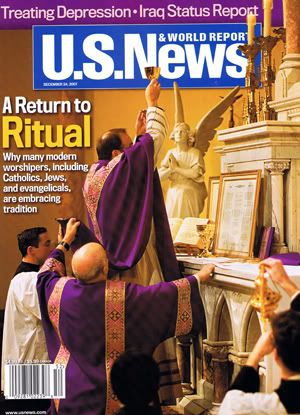
A return to ritual

Photo Sharing and Video Hosting at Photobucket
Is there some connection between the two headlines on this cover of US News & World Report? Treating depression and returning to ritual seem to go hand-in-hand to me. I like how the statue of the angel is gazing toward just the right place.

Actually, the article for the cover story is a very interesting read. It argues that there is a return to ritual across the board, and even in other religions. Here is a snippet:

Something curious is happening in the wide world of faith, something that defies easy explanation or quantification. More substantial than a trend but less organized than a movement, it has to do more with how people practice their religion than with what they believe, though people caught up in this change often find that their beliefs are influenced, if not subtly altered, by the changes in their practice.

Put simply, the development is a return to tradition and orthodoxy, to past practices, observances, and customary ways of worshiping. But it is not simply a return to the past—at least not in all cases. Even while drawing on deep traditional resources, many participants are creating something new within the old forms. They are engaging in what Penn State sociologist of religion Roger Finke calls "innovative returns to tradition."

Read the whole article here.

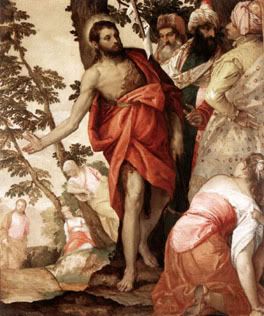
John the Baptist and original sin

Photo Sharing and Video Hosting at Photobucket
In our college bible study last week, the question came up about whether John the Baptist (like Mary) was also immaculately conceived, or somehow free from original sin. I went looking, and Jimmy Akin was very helpful. As he notes in response to a question as to whether John the Baptist was born without original sin:

This is not something that the Catholic Church teaches, but it is what may be called a pious and probable belief among Catholics.

The reason is that in Luke 1:13-15, when an angel prophecies the birth of John the Baptist, he says: “Do not be afraid, Zechariah, for your prayer is heard, and your wife Elizabeth will bear you a son, and you shall call his name John. And you will have joy and gladness, and many will rejoice at his birth; for he will be great before the Lord, and he shall drink no wine nor strong drink, and he will be filled with the Holy Spirit, even from his mother's womb.”

It is commonly understood that the Holy Spirit does not fill those who are still in a state of original sin. As Catholics use the term, "original sin" refers to the privation of the sanctifying grace which unites us with God. A soul filled with the Holy Spirit seems unquestionably to be united with God and thus not deprived of sanctifying grace. Hence, it has not original sin as the term is commonly used among Catholics, just as every person who has been baptized or otherwise justified has not original sin as Catholics use the term.

(N.B., Protestants have a different and more expansive definition of the term "original sin," which includes the corrupt nature we inherit from Adam and which remains with us after we are justified. Consequently, it would sound very improbable to them that any person in this life does not have original sin, but this is because of the way the term is used in their circles, not because of a substantive theological difference.)

(N.B.B., If it is granted that John the Baptist was freed from original sin before birth, it does not follow that he was immaculate, as was the Blessed Virgin Mary. This is firstly because he may have been freed of original sin after his conception and before birth, whereas Mary was preserved from her conception from contracting original sin. And it secondly is because Mary was not only free of original sin, as is posited in the case of John the Baptist, but also utterly free of the stain of original sin, which includes more than just the deprivation of sanctifying grace. It also includes, for example, the later tendency to sin--concupiscence--to which we are subject in this life.)

That was very helpful. I found a similar, but far simpler reference to the idea in the 1917 Encyclopedia of Catholicism on New Advent:

Now during the sixth month, the Annunciation had taken place, and, as Mary had heard from the angel the fact of her cousin's conceiving, she went "with haste" to congratulate her. "And it came to pass, that when Elizabeth heard the salutation of Mary, the infant" -- filled, like the mother, with the Holy Ghost -- "leaped for joy in her womb", as if to acknowledge the presence of his Lord. Then was accomplished the prophetic utterance of the angel that the child should "be filled with the Holy Ghost even from his mother's womb". Now as the presence of any sin whatever is incompatible with the indwelling of the Holy Ghost in the soul, it follows that at this moment John was cleansed from the stain of original sin.

The Oxford Dictionary of the Christian Church also has a little more useful information:

According to tradition (Origen, Ambrose, Jerome, and Leo the Great) John the Baptist was endowed with pre-natal grace at the time of the Visitation of the Blessed Virgin Mary (Luke 1:41). Consequently the Feast of his Nativity . . . was regarded as of a greater solemnity than that of his death.

It may be that the idea has fallen by the wayside in recent decades, for I noticed that this opinion is not mentioned in John Hardon’s Pocket Catholic Dictionary, Richard McBrien’s Encyclopedia of Catholicism, nor in the Catechism of the Catholic Church. As Jimmy Akin points out, part of it has to do with where you start, i.e., with your definition of original sin. In the traditional Catholic definition of original sin (the privation of sanctifying grace) the idea that John the Baptist was "cleansed" of original sin when he was filled with the Holy Spirit makes sense. It is essentially what we would mean by the term "baptism of desire."

Saturday, December 15, 2007

New white and gold vestments

Photo Sharing and Video Hosting at Photobucket

Photo Sharing and Video Hosting at Photobucket

Photo Sharing and Video Hosting at Photobucket
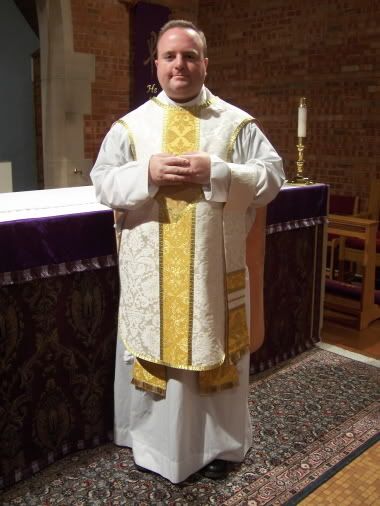
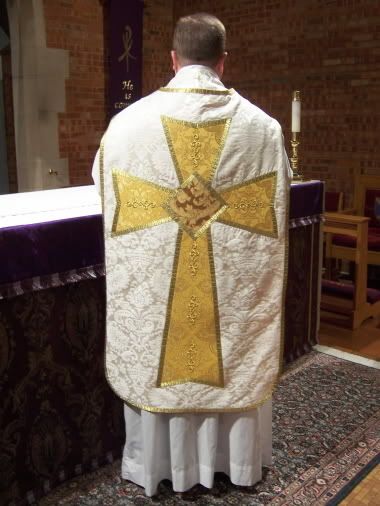
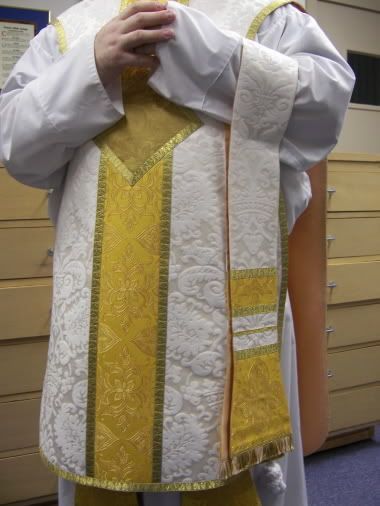
I have completed a low Mass set of white and gold vestments for Fr Ronald Baker and the people of St. Alban's, Hubbard. They will get to enjoy them for Christmas. The purple altar frontal in the background was one I made a few years ago. I am currently finishing up a gold-on-gold set for myself (pictures to come). If you have a project you would like me to consider working on, just email me and we'll talk.

Thursday, December 13, 2007

N T Wright answers the questions

Photo Sharing and Video Hosting at Photobucket
Trevin Wax interviewed Bishop N T Wright of Durham on November 19th for the Said At Southern Podcast. It is worth a listen, for here are some of the highlights:

On the sacraments:
I guess, as an Anglican, there’s always room to move, which can be a dangerous thing, but also a very healthy thing, because bits of the great biblical tradition which you haven’t fully plugged into before you’ve got the space to grow into… not least, the sacraments. You know there’s very little about the sacraments in the teaching I received when I was in my teens, but in my twenties, working with folk for whom that was actually really very important, in a very biblical way… it gave me the space, enabled me to grow.

On the importance of worship:
That’s like saying, “Tell me why breathing is so important to you.” I think if I stopped doing it, I would fall down, or something. I have to look in the mirror and say, “Why is worship important?” Well, it’s what I do. And it’s only comparatively recently, in the last maybe 15 to 20 years that I’ve reflected on why worship is important, which is like somebody who’s always enjoyed eating all their life suddenly reading about the theory of how food works or that sort of thing.

On defining the Gospel:
When Paul talks about “the gospel,” he means “the good news that the crucified and risen Jesus is the Messiah of Israel and therefore the Lord of the world.” Now, that’s about as brief as you can do it. . . . Paul slices straight in with the Isaianic message: Good news! God is becoming King and he is doing it through Jesus! And therefore, phew! God’s justice, God’s peace, God’s world is going to be renewed. And in the middle of that, of course, it’s good news for you and me. But that’s the derivative from, or the corollary of the good news which is a message about Jesus that has a second-order effect on me and you and us.

But the gospel is not itself about
you are this sort of a person and this can happen to you. That’s the result of the gospel rather than the gospel itself. It’s very clear in Romans. Romans 1:3-4: This is the gospel. It’s the message about Jesus Christ descended from David, designated Son of God in power, and then Romans 1:16-17 which says very clearly: “I am not ashamed of the gospel because it is the power of God unto salvation.” That is, salvation is the result of the gospel, not the center of the gospel itself.

On the role of justification:
The doctrine of justification comes into play because the whole plan of God is and has been right since the Fall to sort out the mess that the world is in. We British say “to put the world to rights.” I’ve discovered that that’s not the way Americans say it and people scratch their heads and say, “Funny… what does he mean by that?” It means to fix the thing, to make it all better again. And that is there because God is the Creator God, he doesn’t want to say, “Okay, creation was very good, but I’m scrapping it.” He wants to say, “Creation is so good that I’m going to rescue it.” . . .

Then there is this odd thing that we are called by the gospel to be people who are renewed in advance of that final renewal. And there’s that dynamic which is a salvation dynamic. God’s going to do the great thing in the future, and my goodness, he’s doing it with us already in the present! And then the justification thing comes in because within that narrative, we have also the sense that because the world is wrong and is out of joint and is sinful and all the rest of it, this is also a judicial, a law-court framework, and that’s the law-court language of justification. So we say that the future moment when God will finally do what God will finally do, he will declare, by raising them from the dead: “These people are in the right!” That’s going to happen in the future. And then justification by faith says, that verdict too is anticipated in the present.


On "salvation" versus "justification":
The word “salvation” denotes rescue. Rescue? What from? Well, of course, ultimately death. And since it is sin that colludes with the forces of evil and decay, sin leads to death. So we are rescued from sin and death. Now those may be the same event as the present and future justification. But the word “salvation” and the word “justification” are not interchangeable. It’s as though, supposing we have a class that starts at 9:00 in the morning and suppose that 9:00 in the morning also happens to the be the moment when the sun rises in the middle of winter. Now you can say “sunrise” or you can say “the beginning of class.” Those denote the same moment, but they connote something quite different. One is a statement about things that are going on in the wider world. Another is a statement about something very specific that’s happening this morning in my educational experience. They may be the same moment.

In the same way, justification present and future correspond to salvation present and future, but they’re different language systems to talk about different sorts of events that happen to be taking place at the same time. That’s hugely important. And it happens when we’re reading Isaiah, as well as when we’re reading Paul actually. People have often said, “
Your idea…” (pointing to me) “…that future salvation will be based on the whole life led.” I say, Excuse me. I didn’t write Romans 2:1-16! Romans 2:1-16 is Romans 2:1-16. The evangelical tradition has screened out Romans 2 because it didn’t know what it was there for.

On the Catholic and Protestant views of justification:
I think there’s been an enormous amount of misunderstanding. I have met many Roman Catholic theologians who will emphasize as much as any good Protestant preacher that everything comes from the love and grace of God. The problem again and again has been terminological. And of course at the Reformation, there were many in the Roman system who just didn’t get it and who had been so corrupted by some of the nonsenses that were going on in the late medieval period that they really did believe you had to do all these extra bits and pieces and works of supererogation. And it was hooked into the doctrine of purgatory and all of that. But in terms of the sovereign grace of God, you’ve got that in Thomas Aquinas just as you’ve got it in John Calvin. I think it’s time to stand back and take a much longer, harder look at what’s going on.

On the authority of the Word of God:
I’ve been trying to stress that the risen Jesus does not say to the disciples, “All authority on heaven and earth is given to the books you chaps are going to go off and write.” He says, “All authority on heaven and earth is given to Me.So that if we say that Scripture is authoritative, what we must actually mean is that the authority which is vested in Christ alone is mediated through Scripture. That’s a more complicated thing than simply having a book on the shelf, full of right answers that you can go and look up. It’s more a way of saying that when we read Scripture and determine to live under it, we are actually saying we want to live under the sovereign lordship of Jesus mediated through this book.

When you say it like that, then all sorts of other things happen as a result, like what is the sovereign lordship of Jesus all about? Is it simply to fill our heads with right answers to difficult questions? Well, right answers to difficult questions are better than wrong answers to difficult questions. But no, the authority of Jesus Christ is there to transform and heal and save the world, to make the kingdoms of the world become the kingdom of our God and of his Christ. So the question then is, how does the authority of Scripture serve that purpose?. And that’s actually much more interesting than simply using Scripture to settle or raise indeed doctrinal disputes within the church.

There are many more good nuggets in the interview. You can listen here, or read the transcript here.

Tuesday, December 11, 2007

Why December 25th?

Most people who know some history about the matter think the answer is that the church took a pagan celebration of the birth of the Sun god on the winter solstice (which is when the days start to lengthen again) and set up a rival celebration of Christ's birth--the true Light, dawning in a dark world. That's essentially how Elesha Coffman explains it in this article for Christian History magazine. But is that really the case?

William Tighe says it ain't so in his article "Calculating Christmas," published in Touchtone magazine. He begins:

Many Christians think that Christians celebrate Christ’s birth on December 25th because the church fathers appropriated the date of a pagan festival. Almost no one minds, except for a few groups on the fringes of American Evangelicalism, who seem to think that this makes Christmas itself a pagan festival. But it is perhaps interesting to know that the choice of December 25th is the result of attempts among the earliest Christians to figure out the date of Jesus’ birth based on calendrical calculations that had nothing to do with pagan festivals.

Rather, the pagan festival of the “Birth of the Unconquered Sun” instituted by the Roman Emperor Aurelian on 25 December 274, was almost certainly an attempt to create a pagan alternative to a date that was already of some significance to Roman Christians. Thus the “pagan origins of Christmas” is a myth without historical substance.

Read the whole thing here.